Showing posts with label Empowerment. Show all posts

Thursday, 16 May 2019

Dayalbagh Educational Institute: Spearheading evolution from Homo Sapiens to Homo Spiritualis

Revered Prof. Prem Saran Satsangi while addressing the gathering at the Annual Prize Distribution Function of Dayalbagh Educational Institute's (DEI) Technical College on May 21, 2003 stated that, “The vision of the Founder of Dayalbagh and this Technical College, His Holiness Sir Sahabji Maharaj, was to bring up institutions to serve as models to all those working for the uplift of humanity, whose alumni will be healthy and hard working, not shirk from manual labour and respect those who till and toil with their hands”. DEI continues to work on making this Vision a reality.

In our post today, we have Prof. Prem Kumar Kalra, the Director of Dayalbagh Educational Institute walk us through the approach of the Institute, its past, its present and what plans are there for the future.

Remain committed to selfless service.
Anurag

Dayalbagh Educational Institute:
Spearheading evolution from Homo Sapiens to Homo Spiritualis

Prof. Kalra writes...

The Dayalbagh Educational Institute was founded in 1917 as a co-educational middle school, the Radhasoami Educational Institute, by the August founder of Dayalbagh, Sir Anand Sarup. The Dayalbagh community emphasizes nurturing of one’s spiritual and intuitive faculties through Surat Shabd Yoga. Dayalbagh itself is a century-old, living example of cooperative co-existence, self-sufficiency and self-reliance, untouched by the swinging pendulum of inflation, and DEI was nurtured with these same set of values, practices and morals.


DEI: Hallowed Corridors of Learning
Foreseeing the challenges of the future, the founders of DEI emphasized skilling and the importance of working with one’s own hands. In 1917, an industrial park called Model Industries was established in Dayalbagh, which offered opportunities for apprenticeship to students at the middle school level, in addition to providing employment to the community’s residents. Vocationalization of skills was thus integrated into DEI education from its inception.


Skilling in the AAM Karkhana
In 1916, community-based farming was initiated on a small scale, which grew into full-fledged agricultural operations on 1250 acres of land by 1941. Daily field work is part of life for every member of the Dayalbagh community. Dayalbagh also set up Asia’s best Dairy processing plant in 1926, and these initiatives created a sustainable model of living and material minimalism.


Children of REI: Bonding with Mother Earth
DEI’s education is rooted in its Educational Policy of 1975, the Architect of which was Revered Prof. Makund Behari Lal Sahab, Himself an outstanding academician, teacher and educationist. An alumnus of Lucknow University, He went on to obtain the D.Sc. degree in Zoology from the University of Edinburgh and returned to Lucknow University eventually becoming its Vice-Chancellor. And through His dedicated effort, Government of India conferred the status of a Deemed University on Dayalbagh Educational Institute (DEI) on 16th May, 1981.

The mission objective of DEI education is to evolve a complete person through physical, intellectual, emotional and ethical integration. The Policy, which is rooted in Indian culture, philosophy and spirituality, outlines how this may be achieved via its Aims & Objectives, Educational and Organizational structures.

The DEI Education Policy was a disruptive innovation in higher education and followed a systems approach that integrated social and environmental systems with formal systems of education. This allowed DEI to evolve at the pace at which social needs and the world order was changing. It benefited society at large by encouraging sustainable, frugal innovation through optimization of economy, energy and resources. The Education Policy also emphatically enunciated the centrality of values-based education and ‘excellence with relevance’, and this is practiced throughout DEI, from pre-primary to higher education.


Values instilled in our minds and inscribed on the walls of REI Hall
A unique aspect of DEI is the integration of education from pre-nursery to Ph.D. on the one side, and skilling to entrepreneurship as part of formal education on the other. The opportunity for mobility from general to skill-based education and vice versa through well-defined pathways has spurred creativity, frugal innovation and an entrepreneurial mindset in our students. Introduction of vocational courses (B.Voc. and M.Voc.) at Bachelor’s and Master’s level has taken skilling education to the next level. Synthesis of mainstream education and entrepreneurship has led to “Earn while Learn”, on-campus enterprises in dairy, food processing, automobiles, apparel design etc. These opportunities provide students with a means to support their education.

B. Voc. Dairy Students
DEI has created an ecosystem that encourages innovative ideas from young students on socially relevant problems, and we have tried to facilitate the transformation of these ‘idea quanta’ into frugal or jugaad solutions. We call this harnessing of small, frugal innovations ‘Quantum Jugaad’, and it has led to the creation of many student-run, on-campus enterprises. These naturally evolving, and exponentially growing student-run enterprises have given an entrepreneurial flavor to teaching and learning. But the meaning of entrepreneurship here is not innovation that leads to revenue-driven venture creation, but rather, the creation of value through social, economic or environmental ventures that benefit the lowest and the least among our masses.


DEI Quantum Jugaad: Incubating Nano Enterprises
Innovation, whether incremental, procedural, need-based or blue ocean type, always follows the SIGMA SIX Q framework of the Institute, which weaves six basic threads together, and emphasizes in improving the QUALITY(Q) of life. The sum (Sigma) of these six is greater than the individual parts. The areas are:
(i) Innovation including generation & use of renewable energy
(ii) Water quality
(iii) Air quality
(iv) Education and healthcare
(v) Agriculture and dairy practices
(vi) Quality and Values.


The Sigma Six Q Model


I would like to discuss here the link between innovation and system thinking in education. Innovation is not driven by technology alone (hardwired innovation); it can as well be driven by a change in one’s way of thinking, or through emergence of new knowledge, or even a change in the mindset that one brings to a problem (soft innovation). Educational institutes can innovate by providing new learning organizations and new pathways such as skill development and opportunities for analysis, synthesis, experiential experiments, teaching- learning methodologies and creative technological interventions. These then lead to innovative design of curricula, emergence of new knowledge and new pathways for student mobility. Ecology, energy and economy optimization too, are good reasons to motivate creative innovation. A combination of these ideas leads to frugal innovation that evolves continuously and dynamically over all time to come.


At the IITs, Prof. P. K. Kelkar introduced science-based engineering education that included social sciences. This approach gave young engineering graduates a wide knowledge base, and an edge in solving complex social problems economically, by using local resources. Prof. Mo Jamshidi of University of Texas, was of the view that methods of education must be refined and expanded to meet changing needs from a system to a system-of-systems vision, from a disciplinary to a multidisciplinary outlook, from a steady state to a real-time perspective, and from an optimal to an adaptive approach.

Innovative evolutionary approach in our education conforms to the philosophy of “Renaissance Man” by Prof. Jay W. Forrester of MIT, one who has broad intellectual interests and is accomplished in areas of both the arts and the sciences. Such a person tries to see common elements in diverse settings and thus creates transfer-ability between diverse structures, which is one of the hallmarks of the systems approach.

Norbert Wiener’s prediction in 1950 that electronic computers were capable of taking over many human decision-making processes has come true today, raising an array of crucial ethical and moral issues: Are humans in danger of becoming slaves to these machines? Will such machines have autonomous thinking and resultant morals, or will the designers consciously or unconsciously build into them their own moral values? And who we will turn to for proper answers? Prof. Rajaraman says that common-sense knowledge, religious beliefs, and consciousness will be the drivers, and we, at DEI, have set ourselves the huge challenge of not only instilling in our students the thought process to address social change, but also how to adopt and adapt technology to answer some of the questions raised above.

Under the guidance and direction of Prof. Prem Saran Satsangi the scientific study of consciousness and ultra-transcendental meditation is undertaken at DEI’s Centre for Consciousness Studies. Experiential knowledge of 150 years of spiritual practice by the members of the Dayalbagh community has given DEI a living laboratory to analyse the phenomena of consciousness practically, as also the effects of ultra-transcendental meditation. But this, much required discipline is yet to become part of formal education elsewhere.


'The Science of Consciousness (TSC)' Conference at DEI

DEI aims to become a leading research-cum-teaching institute in Consciousness Studies. In DEI this pursuit is carried out by bringing together teachers, researchers and students from various disciplines like psychology and cognitive science, physics, mathematics, life science, language studies, arts and music, engineering management etc. This truly trans-disciplinary study has unfolded many aspects of human behavior, psychology and functioning of the brain. Rigorous scientific research is being carried out to understand the experiential science through experimental techniques.

The Strategic Plan will be anchored by an accountability framework through measurable inputs and deliverables that monitor progress towards our goals. Over the next five years, building on our foundational strengths and propelled by the promises outlined in this Strategic Plan, DEI will emerge as an institute with excellence in specific disciplines and strong societal outreach that delivers holistic education to every learner.


Total Quality Management in Higher Education
The DEI will leverage its strength, taking advantage of the opportunities to overcome the existing weaknesses to reach the goals. We will allocate our resources in the areas that sets us apart and will align our future resources with the upcoming deliverables to become leading research and teaching institute in agriculture, entrepreneurship and consciousness while sustaining other areas of research in the institute. Learning ecosystem in DEI will be enhanced through experiential learning by connecting class rooms, labs and research to real world problems.

DEI’s Strategic Plan charts the distinctive course expected of an institution with a long and distinguished history. It builds on the traditions of excellence established by our founders, with a clear view of our strengths, opportunities and weaknesses.

DEI has chalked out a bold 15-year strategic plan (Vision 2031) and aspires to become an Institution of Excellence in the areas of Consciousness, Agriculture and Entrepreneurship. I do not think any other institute offers such a broad spectrum of integration on one platform.

We hope to help in the creation of a race of ‘Supermen’, who would be set apart from the rest of humanity, by their quality, character, behavior, values and ideals, and their desire to serve. The recent scheme of Evolutionary Superman (popularly known as the ‘Sant-Su Scheme’) for children of age 3-months to 3- years is the first step in this journey. As regular participants in the agricultural field work every day, these children gain good sanskaras from a very tender age. In 2018, we were happy to host them at DEI on our Founder’s Day, and we consider them our pre-pre-nursery students!

Supermen in the making: Learning to cohabit on our planet


Saturday, 4 May 2019

शिक्षा के माध्यम से महिला सशक्तिकरण

This is a translation of our post from 18th August 2017 on “Empowering Women through Education”

गांधी जी का कथन है कि यदि हम एक पुरुष को शिक्षित करते हैं, तो केवल एक व्यक्ति ही शिक्षित होता है, लेकिन एक महिला को शिक्षित करने से पूरा समाज शिक्षित होता है।

मेरी माँ, मौसियाँ व दयालबाग़ की उनकी अन्य हमउम्र स्त्रियों का शिक्षा का स्तर अचंभित करता है। यहाँ कई महिलाएँ डॉक्टरेट की डिग्री युक्त हैं और कोई भी महिला स्नातक डिग्री से वंचित नज़र नहीं आती।

भारत के सेंसस आँकड़ो के अनुसार सन् 1951 तक महिला शिक्षा 8.81% थी और सन् 1961 में यह 15.35% हो गई। उस समय वे सभी शिक्षित माने जाते थे जो पाँच वर्ष आयु से अधिक के थे और लिखा हुआ पढ़ सकते थे। उसी समय, यानी की 1950-60 में दयालबाग़ में एक ऐसा महिला समाज था जहाँ सभी महिलाएँ 100% पढ़ी लिखी थीं और कई युवा महिला स्नातक, स्नातकोत्तर या डॉक्टरेट की डिग्री धारी थीं।

आज की पोस्ट में हम 60 वर्ष पूर्व सन 1955-60 के समय को चित्रित कर रहे हैं जब दयालबाग़ में शिक्षा द्वारा महिलाओं को सबल और प्रगतिशील बनाया जा रहा था।

यह लेख डॉ दयाल प्यारी सिंह द्वारा वर्णित है, जो कि प्रेम विद्यालय गर्ल्ज़ इंटर कॉलेज की पूर्व छात्रा हैं व उन्होने बीऐ व बीटी विमेंस ट्रेनिंग कॉलेज दयालबाग़ से सन् 1958-59 में की। तत्पश्चात वह निरंतर आगे बढ़ते हुए महारानी लक्ष्मीबाई गर्ल्ज़ पोस्ट ग्रैजूएट शासकीय (स्वशासी) महाविद्यालय, भोपाल की प्रचार्या बनीं तथा शिक्षा के कार्य को आगे बढ़ाने का नेतृत्व किया।

सस्नेह,
अनुराग

डॉ दयाल प्यारी सिंह लिखती हैं...

शिक्षा के माध्यम से महिला सशक्तिकरण

दयालबाग़ की नीव 20 जनवरी 1915 में, बसंत पंचमी के पावन दिन, परम श्रद्धेय सर आनंद स्वरूप जी ने, अपने अनुयाईयों के लिए एक आश्रम व आध्यात्मिक गृह के रूप में डाली थी। स्थापना के अगले ही दिन दयालबाग़ में प्रथम भवन निर्माण की नींव रखी गयी, जो की शिक्षा के लिए थी। यही भवन राधास्वामी एजुकेशनल इन्स्टिट्यूट (REI) तथा बाद में दयालबाग़ एजुकेशनल इन्स्टिट्यूट (DEI) बना। परम पूज्य आनंद स्वरूप जी ने कटीली झाड़ियों व धारदार पौधों से लदी रेतीली ज़मीन पर अपनी छड़ी से पोईया घाट के समानांतर, दक्षिण से उत्तर तक एक सीधी रेखा खींच दी। इस सीधी रेखा ने शीघ्र अपना आकार, श्रद्धेय मेहता जी महाराज की देख रेख में, एक बड़े निर्माण का रूप धारण किया। इसके लाल ईंट से निर्मित बड़े आकार के गॉथिक घुमावदार आर्चेज़ (तोरन) सूर्य की लाल-लाल किरणों से एकीकृत हो अति आकर्षक नज़ारा पेश करते हैं।

राधास्वामी एजुकेशनल इन्स्टिट्यूट का भवन

शिक्षा प्रणाली में आरम्भ से ही (1 जनवरी 1917) अनेक उच्च स्तरीय क्रियाएँ शामिल थीं जो कि नींव के संस्थापक के महान दूरदर्शी स्वप्न का प्रतीक हैं। उनमें से एक उल्लेखनीय प्रगतिशील क्रिया थी सह-शिक्षा। आरम्भ से ही पहली से पाँचवी कक्षा तक के लड़के-लड़कियों के लिए सह-शिक्षा (co-educational classes) का प्रबंध व आयोजन किया गया। यह वह समय था जब माता-पिता लड़कियों को पढ़ने भेजने में हिचकिचाते थे, वहीं दयालबाग़ में ऐसा स्कूल था जहाँ लड़के लड़कियाँ साथ पढ़ायी करते थे।

14 अक्टूबर 1918 को राधास्वामी सतसंग सभा ने एक महत्वपूर्ण प्रस्ताव को पारित किया जिससे दयालबाग़ में रहने वाले लड़के व लड़कियों को प्राइमरी शिक्षा ग्रहण करना अनिवार्य किया गया। भारत में उस समय डेढ़ प्रतिशत महिलाएँ साक्षर थीं। उसी बैठक में लड़कियों के लिए मिडल व सीनीयर स्कूल खोलने के प्रस्ताव को भी सहमति मिली।

परम श्रद्धेय आनंद स्वरूप जी का विश्वास था कि बच्चों के चरित्र निर्माण में महिलाओं की अति महत्वपूर्ण भूमिका है। उन्होंने स्पष्ट रूप से, प्रभावशाली शब्दों में कहा कि आनेवाली पीढ़ी के मानसिक, नैतिक व आध्यात्मिक विकास महिलाओं पे निर्भर है। उन्होंने आगे कहा कि हमें समझ लेना चाहिए कि जब तक लड़कियों का पालन-पोषण व उनकी शिक्षा ठीक ढंग से क्रियान्वित नहीं की जाएगी, तब तक सतसंग समाज उन्नति नहीं कर सकता।

उनका सोचना था कि भारत की उन्नति स्त्रियों पर निर्भर है और वह चाहते थे कि सतसंगी इस बात पर ख़ास ध्यान देवें और अपनी बेटियों व बहनों की शिक्षा हेतु सही इंतज़ाम करें।

विमेंस ट्रेनिंग कॉलेज के अध्यापक

इसी विचार को कार्यान्वित कर छात्राओं के लिए सन् 1930 में एक मिडिल स्कूल, प्रेम विद्यालय आरम्भ किया गया जिसे चार वर्ष बाद हाई स्कूल और तत्पश्चात 1939 में इंटर्मीडीयट तक उन्नत किया गया।

परम श्रद्धेय मेहता जी महाराज ने स्त्री शिक्षा को आगे बढ़ाने हेतु विचार अत्यंत प्रेरणादायी शब्दों में अभिव्यक्त किए कि भारत अपनी महिला समुदाय से आशा करता है कि वे अपने अंदर शिक्षा की लौ प्रज्वलित करेंगी तथा ज्ञान की रोशनी से अपने चारों ओर फैले अज्ञान के अंधकार को दूर कर, घृणा, आपसी लड़ायी-झगड़े को हटाकर, प्रेम व शांति का वातावरण निर्मित करेंगी।


सन् 1947 में विमेंस ट्रेनिंग कॉलेज के उद्घाटन के अवसर पर परम श्रद्धेय मेहता जी ने कहा कि मैनेजिंग कमिटी आर ई आइ ने विमेंस ट्रेनिंग कॉलेज (WTC) आरम्भ किया है ताकि युवा महिलाएँ जिन्हें स्नातक उपाधि प्राप्त है, उन्हें नौकरी के लिए कार्य कुशलता की ट्रेनिंग दी जा सके। उन्होंने यह भी फ़रमाया कि उनका विश्वास है कि पढ़ी लिखी युवा महिलाएँ अपने घर व बाहर एक आदर्श उदाहरण स्थापित करेंगी।

सुखिया बहेनजी - प्राध्यापिका


मेरा जन्म बाँदा ज़िला, उत्तर प्रदेश में हुआ, जहाँ पर लड़कियों की शिक्षा हेतु दसवीं कक्षा तक का एक सरकारी स्कूल था। वर्ष 1954 में मेरे माता पिता ने हम भाई बहनों को दयालबाग़ भेज दिया जहाँ शिक्षा की पूर्ण सुविधाएँ थीं। शिक्षा का स्तर उँचा था, वातावरण सुंदर, सुरक्षित व उच्च मूल्यों व आदर्शों से परिपूर्ण था।

जब मैं अपनी बहनों के साथ दयालबाग़ आई तो पाया कि लड़कियों की शिक्षा पर यहाँ विशेष ज़ोर था तथा किसी प्रकार का जात-पात, रंग-भेद, ऊँच-नीच आदि का नामोनिशान नहीं था। स्वस्थ वातावरण गवाह था कि प्रत्येक छात्रा अच्छी शिक्षा प्राप्त करेगी। प्रेम विद्यालय तथा विमेंस ट्रेनिंग कॉलेज ने लड़कियों को सबल  सशक्त बनाने में बहुत ही अहम भूमिका अदा की है। छात्रा के सर्वागीण विकास ही संस्थाओं का लक्ष्य था और इसी कारण पास के शहरों  राज्यों से छात्राएँ यहाँ पढ़ने आती थीं। शिक्षक वर्ग उच्च स्तरीय शिक्षा प्राप्त था। योग्य छात्राओं हेतु विशेष छात्रवृति का प्रबन्ध था।

एक अन्य उल्लेखनीय श्रेत्र वोकेशनल शिक्षा का था। मुझे व मेरी बहनों व अन्य छात्राओं को उचित नौकरी प्राप्त करने में इस कारण बहुत मदद मिली। आज यह पूर्व छात्राएँ शिक्षा जगत के उच्च पदों पर स्थापित हैं तथा महाविद्यालय की यादें दिल में संजोये हैं।

यूथ फ़ेस्टिवल टीम तीन मूर्ति भवन में

कॉलेज द्वारा प्रस्तुत सांस्कृतिक कार्यक्रम उच्च स्तर के होते थे। मुझे व मेरी सहपाठी छात्राओं को दिल्ली के तालकटोरा ग्राउंड में आयोजित यूथ फ़ेस्टिवल में, आगरा यूनिवर्सिटी का प्रतिनिधित्व करने का सौभाग्य भी प्राप्त हुआ। WTC का समूह नृत्य बहुत सराहा गया व राष्ट्रपति भवन के at home व तीन मूर्ति भवन में पंडित नेहरु ने हमारा मनोबल बढ़ाया।

खेलकूद भी स्त्री शिक्षा का अभिन्न अंग था, जिसमें वॉलीबॉल, खो-खो और कबड्डी लड़कियों के मनपसंद खेल थे। कॉलेज के NCC विंग में हर रविवार राइफ़ल शूटिंग व परेड में छात्रायें शामिल होती थीं।

आज भी यह मूल्यपरख शिक्षा, महिलाओं के सर्वांगीण विकास हेतु आयोजित होती है और महिला सशक्तिकरण को मजबूती प्रदान कर रही है।

Wednesday, 13 February 2019

AAM Karkhana

In the Dayalbagh Educational Institute's (DEI) Education Policy, articulated in 1975, two of the foundational concepts are to build ideals of humility, simple living, selfless service and sacrifice and to develop respect for ‘soiled hands’, dignity of labour, and, self-reliance.

UGC's visiting team to DEI in 1977 observed that DEI is engaged in providing a good academic programme in agricultural-rural-industrial complex, oriented to specific conditions and needs and providing suitable social service, work experience, national integration and vocational training programmes aligning with academic curricula. They further observed, that DEI, with its courses, is able to give a greater emphasis on preparing students for self-reliance and self-employment and thus fulfill its objective more effectively.

Today's post is on one such initiative, an initiative in the remote tribal areas of Middle India, to enhance the skills of tribal youth, helping them start and establish nano-enterprises and making them self-reliant, an initiative called AAM Karkhana.

Read on,
Anurag

Automobile And Multi-Skill (AAM) Karkhana

The education system in Dayalbagh is over a hundred years old and two of its important features are: vocational education and training, and selfless service to the underprivileged. The educational system is underpinned by the philosophy of social responsibility by way of providing low-cost, high-quality education and training locally. Accordingly, DEI not only offers programs and courses in engineering and management but also offers modular programs to persons who are unable to continue with higher studies for any reason, academic, financial or domestic. DEI has taken need-based courses to remote locations of the country for tribal and unprivileged sections of society.

Disseminating Information: Roadshow by Yamaha Motors

Disseminating Information: Village Chaupal

The AAM (Automobile and Multi-skilling) Kharkhana was established at Rajaborari by DEI’s Centre of Rural Entrepreneurship (CORE) and Technical College with the help of India Yamaha Motor Pvt Ltd (IYMPL), Surajpur. The objectives of the AAM Kharkhana include:

  1. Skill enhancement of local tribal youth in repair of automobiles, agro-farm equipment, electric appliances, iron fabrication/welding etc.
  2. Establishment of a common resource center for young entrepreneurs for skilling and entrepreneurial experimentation.
  3. Extending sustainable self-employment opportunities in remote tribal areas.


The AAM Karkhana at Rajaborari is fully equipped with essential equipment for automobile service and repair such as tools, air compressors, washing units, hydraulic two-wheeler ramps, spark plug cleaners and testers. The Karkhana is also equipped with a motor winding machine, welding machine, and drill machine, etc., for repair of electric appliances, and iron fabrication/welding jobs. AAM offers services to the local population in the above fields at competitive rates and provides opportunities to the tribal youth for training and self-employment. The trainee, after acquiring adequate skills, can even work at the Karkhana on payment of nominal charges towards rent for space and tools and equipment, electricity and water charges, etc. Experts from the Department of Automobile Engineering, DEI Technical College are regularly sent on deputation to Rajaborari to train the local youth. An expert welder from a nearby village, Temrubahar, in the Rajaborari estate akes on fabrication jobs and trains those interested in welding.

Motorcycle service and repair - early days, without AAM Karkhana shed
AAM Karkhana duly established
Motorcycle being serviced in the AAM Karkhana.

Motorcycle being serviced in the AAM Karkhana.
Motor winding jobs at the AAM Karkhana.

Welding jobs being attended to at the AAM Karkhana.

Earlier, the local residents of Rajaborari Estate (comprising 10 villages with a population of over 5000 people) had to go to Timarni (55 km away) to have their vehicles serviced or repaired. This is now possible locally at very reasonable rates, saving time, energy, and money.

The AAM Workshop also serves as a shared ‘Rural Resource Centre’ where anyone can come and use the equipment for his private or commercial use at a very nominal fee. Two companies, IYMPL and Mahindra were informed that the villagers come to the Karkhana in large numbers and asked if they would like to organize free service camps (FSC) in the Basant Mela, a local fair of importance, to be held between 7 – 10 February 2017. Both agreed and their stalls were a great success with 213 motorcycles, 4 tractors and 3 SUVs serviced in the camp; the villagers requested that such camps be organized regularly.
Free Service Camp by IYMPL

Motorcycle washing at Free Service Camp

Free Service Camp by Mahindra

Mahindra vehicle being attended at Free Service Camp

Beneficiary Testimonials:
  • “I have undergone six-month two-wheeler automobile repair training at AAM Karkhana Rajaborari. The DEI Technical College has also arranged and sponsored twenty-day training for me at India Yamaha Motor Pvt. Ltd, Surajpur (near Noida). I have now started my own flour mill cum automobile repair shop in my village which provides livelihood to my family.” - Mr. Ashok Uikey, Tribal Youth, Village Rajaborari, Dist. Harda (M.P.)


  • “I belong to village Temrubahar (a Korku tribal village) in district Harda. I am using the welding equipment and infrastructure of AAM Karkhana, Rajaborari for my self-employment purposes. I was working in a factory at Bhopal as welder but now I have relocated back to my village and started my own welding services by using AAM Karkhana equipment (welding machine, cutter, power back-up etc.). I am simultaneously managing my agriculture operations as well. I have earned Rs. 50,000 in past six months from my welding jobs without making any investment in the costly equipment and power back-up in this rural area” - Mr. Sukhdev Bhusare, Korku Tribe, Village Temrubahar


  • “I have completed my one-year certificate program in Motor Vehicle Mechanic (MVM) from DEI and am presently working at the AAM Karkhana since past two months. I will open up my own workshop in my village Mogradhana in times to come.” - Mr. Anand Raj Bhalavi, Korku Tribe, Village Mogradhana

  • “My name is Gurdayal Yadav and I belong to village Mogradhana. My father is a farmer and we also have a small kirana shop in our house. I attend training at the AAM Karkhana in the forenoon and help my old father in managing the shop in the afternoon. I have plans to take loan after my training and expand my current shop to include automobile repairs as well.” - Mr. Gurudayal Yadav, Rural Youth, Village Mogradhana

Sunday, 13 January 2019

Agriculture and Dairy Education

Revered Prof. Prem Saran Satsangi, on 6th of July 2014, while explaining the Dayalbagh Way of Life and Agriculture and Dairying forming the fifth component of the Sigma Six Q model, stated, “Agriculture gives us opportunity to do selfless service and it is recognized in the country that there is still great opportunity to develop agriculture. It won’t be enough if we give emphasis to industry only. If we want to reach our progress in the country to all sections of people in Society, it is necessary to introduce entrepreneurship, innovation etc. in agriculture also for realizing desired progress and development”.

Agriculture Operations is an essential element of the education system at the Dayalbagh Educational Institute (DEI). In the article below, Prof. Prem Kumar Dantu takes us through the 
‘Agriculture and Dairy Education at DEI’.

Eat well,
Anurag

Prof. Dantu writes...

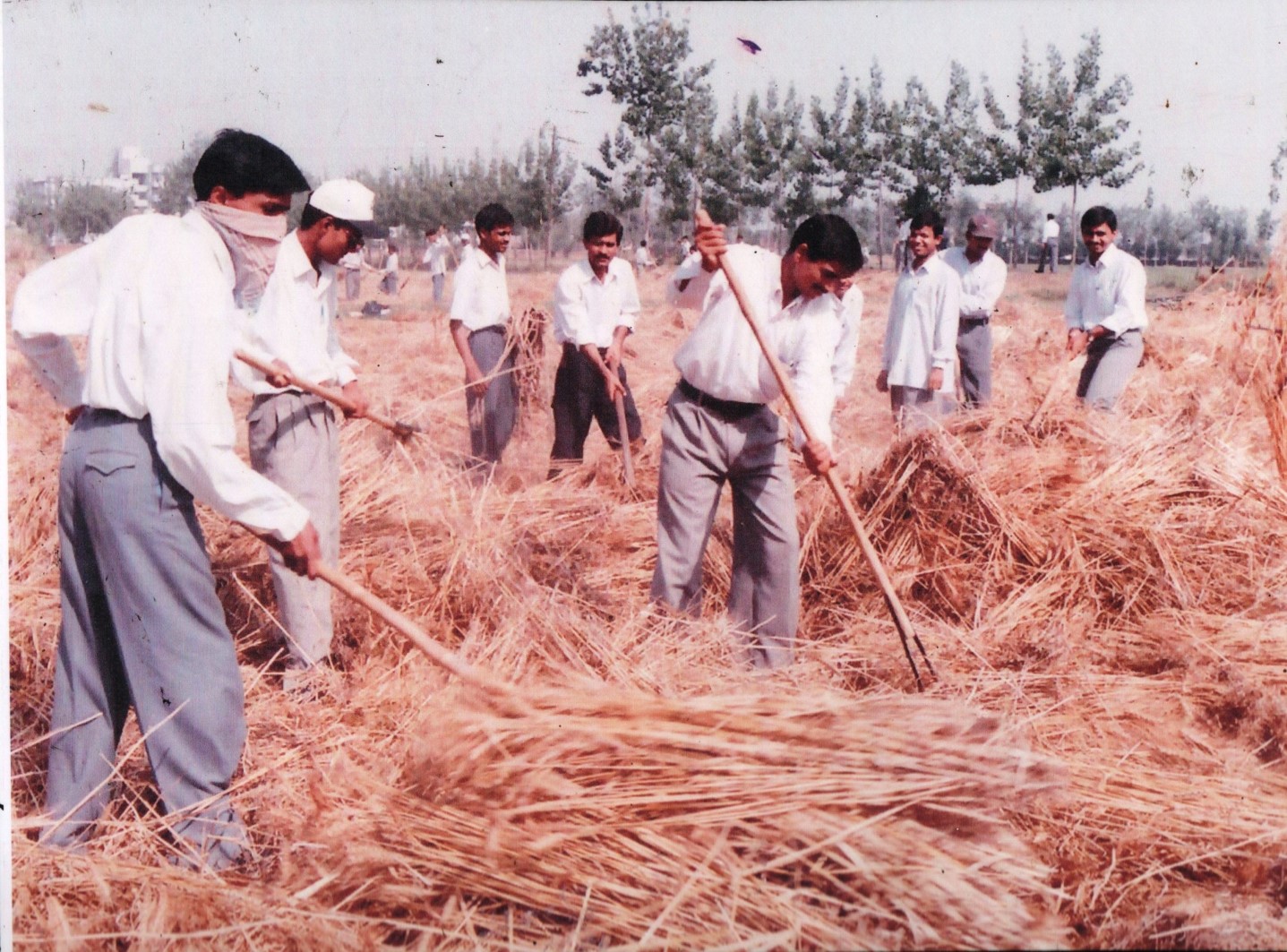
Agriculture operation in Dayalbagh has a hundred-year history. It is a need-based, sustainable, eco-friendly, and a scientific endeavour. Dayalbagh is self-sufficient in food for its residents and pilgrims and produces enough green fodder and bhusa (straw) for its Gaushala (Cowshed). In addition, it produces several fruits and herbs for Dayalbagh Pharmacy. Most of the agriculture operations are performed on a voluntary basis. This voluntary seva (selfless service) based agriculture model, on a smaller scale, is also practiced in Dayalbagh colonies in other parts of the country, such as Rajaborari and Timarni in M.P., Murar in Bihar, MTV Puram in Tamil Nadu, and Kakinada and Vishakapatnam in Andhra Pradesh. Hundreds of volunteers work together in the farms, every morning and evening irrespective of their age, gender, class, caste, and status.

Turning of harvested wheat plants
The Education Policy of Dayalbagh Educational Institute, penned by Revered Dr. M. B. Lal Sahab, highlights the importance of Agriculture Operations as an essential element of the education system of the Institute. The Policy also emphasizes that the Head of the Institute, himself/ herself have an “active involvement in field work so as to infuse staff and students with enthusiasm”. Dayalbagh agriculture operates on scientific principles for which there is a RSSAF Scientific Advisory Committee.

Demonstration of Power Thresher
Agriculture Operations and Rural Development are mandatory core courses for students of all streams in DEI, with students participating in and getting hands-on training in all aspects of agriculture. Further, under NSS, students participate in various farm related and rural development activities. On Sundays, students in large numbers do field work. Students also participate in Gaushala maintenance, Dairy, herbal garden maintenance, biodiversity park development, and mushroom cultivation.

Demonstration of Disc Harrowing
There are plans to start precision farming to optimize utilization of manpower, irrigation water, and soil addendum, and to train students in the modern methods of cultivation. DEI has initiated agriculture education by starting undergraduate courses in B.Sc. Applied Botany and B. Voc. Agriculture Technology and an MBA programme in Agriculture Management.

Harvesting of Barseem
Activities in Progress

Energy conservation and reducing Diesel usage

Wheat, Gram, Mustard, Masoor, Baajra, Barseem and Barley are sown in Dayalbagh every year. Threshing is done to take out the seeds from these crops. The threshers are driven by 3-phase AC induction motors, with the system designed in DEI in collaboration with the Agriculture Department of Dayalbagh.


The electric distribution system for running the threshers with electric motors is designed in DEI with protections, metering, and alarms and appropriately sized cables to minimize voltage drop and losses. Three of the threshing machines run on solar power generated in DEI, reducing the electricity consumption from the Grid and potential downtime due to power failure. A dedicated solar power plant of 50kWp capacity is installed in the Dairy and Agriculture complex. A 20kW capacity Bio-gas plant is being commissioned and will be integrated through a Smart Micro Grid.

Ground water conservation through rain water harvesting and use of sewage treated water
Much of the agricultural irrigation in Dayalbagh is done through sewage treated water from the Sewage Treatment Plant (STP) situated at Dayalbagh. DEI helps Dayalbagh maintain the STP motors for pumping the treated water into canals for irrigation. A Short Messaging Service (SMS) based embedded system for remote monitoring and control of STP pumps has been designed and deployed by the students of DEI.


Integrated solar farming with remote controlled solar assisted micro-irrigation system for local energy use and better farm productivity
The concept of a solar agriculture farm is being developed in DEI. A novel sun-tracking structure has been developed that accommodates 50 solar modules at a minimum ground clearance of 12 feet, thereby facilitating multiple land use, viz. solar-agriculture farm where agriculture can be performed in the land beneath the solar modules. Combination of solar farming with agriculture increases the land yield. The cost of module support structure is compensated by the cost of the land salvaged. This will allow for a through the year solar crop even if the agricultural crop gets affected due to insufficient rains/ otherwise. These multiple land use models would allow large MW size solar plants to be installed near load centres and sub-stations, reducing the cost of grid infrastructure required when these solar power plants are installed on distant barren lands.


Mobile SPV plants for irrigation and other applications
Mobile SPV plants are being developed at DEI which are mounted on a trolley or a vehicle to be used for irrigation in rural areas where erratic or absent electric supply. The vehicle may be towed using a tractor with the SPV modules folded. Whenever required, the SPV modules can be unfolded (manually or motorized) to capture sun light and can power the irrigation pumps or for other uses. A multi-purpose variable frequency drive may be used for irrigation pumps as well as other applications. Typical sizes are 2 – 5 kWp capacity.

Proposed activities

Village Distributed Energy Resource (DER) Grid
Design and development of village DER Grid which would comprise of Irrigation Micro Grid and Residential Micro Grid with possible interoperability. Both micro grids have different load profiles and hence the separation.

Renewable energy solutions for completing the value chain for farmers located at remote places without access to reliable electricity
Extending the village DER grids/ designing efficient and economic stand-alone SPV plants to power cold storages, driers, winnowers, flour/ dal mills, husking machines etc. and complete the value chain for empowering the farmers at remote locations to grow crops of their choice and to get better agricultural land yields.

Data aggregation, data analytics, Machine Learning applications for Village micro grids
Precision agriculture involving sensors, embedded controllers and drip irrigation systems are going to be essential for future organic agriculture. Integrating the sensor data, weather logs and the solar data logs would be useful for efficient irrigation and precision farming. Modern Machine Learning techniques can be used to study and infer potential threats, economics and reliability of the system. Development of such handy software tools will help ensure efficient, economic and reliable operations of DER micro grids encompassing precision agriculture. Cloud storage servers would enable remote monitoring, analysis and control of village DER grids and agriculture.

Drones for precision farming application and surveillance
It is proposed to work on this area for localizing weeds and diseases, determining soil properties, detecting vegetative differences in farms associated with Dayalbagh. However, because of legal restrictions the drone payload should not exceed 5 kg.

Sustainable Development Solutions through Strategic Planning in Agriculture via Interactive Management Strategy
Idea Engineering, Fuzzy DELPHI, Option Field and Option Profile Methodologies along with Scenario Building Exercise and many other techniques of interactive management and system design to be utilized for solutions using Second Generation System Design Paradigm for the said sustainable agriculture initiatives. Such initiatives at sub-system level in Dayalbagh Farming System may be a starting point where deliverables could be used and closely monitored for further nurturing and modifications.

Hydraulic Ram (HYDRAM) for water lifting as a green irrigation initiative
The use of eco-friendly HYDRAM at different identified locations in the farm may reduce costs. A pilot study on use of HYDRAM is proposed.

Sprinkler Systems as Rain-fall Simulators
Besides, other promising areas viz. pico power generation, environmental protection practices, technology assisted organic farming, training and learning initiatives for farmers, students and stakeholders can also be explored and pursued.

Rural Development and Empowering Rural Women

DEI has embarked on a new educational pedagogy of engaging, educating, and improving skills of the rural women. In the remote tribal zones of Madhya Pradesh, ADyNaM (Agri Dairy Nano Processing of Multi-products) Foods has been set up. ADyNaM is a facility for processing of the agricultural and dairy-based raw produce to make secondary products. Women are trained on the production of pickles, chutney, amla candy, and squashes. Recently, a level-1 food testing laboratory has been setup to implement quality control, and to comply with the food safety standards.

Agriculture Education at DEI

In order that the experiential knowledge that Dayalbagh and DEI collectively possess benefits the society at large and contributes to the Nation, Faculty of Agriculture is proposed to be established by DEI after obtaining the necessary approvals and permissions. The Department of Botany got approvals from UGC to start two new courses namely B.Sc. (Hons) Applied Botany and B. Voc. Agriculture Technology from 2017. The Department of Management has initiated an MBA programme in Agriculture Management from 2017 session.

B. Voc. Agriculture Technology students sowing groundnut

Agriculture Operations in Dairying

RSS (Radhasoami Satsang Sabha) Gaushala in collaboration with DEI is transforming into a state-of-the-art Gaushala with the use of RFID, ICT tools, management software, sensors, and modern practices for precise management of nutrition, health, and breeding of cattle. The objective is to develop RSS Gaushala and DEI into a centre of excellence for precision Dairy Farming and Dairy Technology. The effort is to increase milk yield by improving nutrition, health, and breed of the cattle.

Breeding: Database management for maintaining all breeding records using precision Dairy farming software system. The database also records data on heat/ A.I./ calving/ milk yield/ treatment etc. are maintained.

Feeding: Feed planning originates from cultivation of our own crops. Extensive agricultural operations spread over 800 acres and wide range of crops balanced between crops for human and animal consumption is maintained. Each product of crop & its by-product is utilised. Emphasis is on quality & quantity of green fodder, which is the natural and cheapest source of protein. Silage preparation is also done to cater for the lean period.

Facilities Management: Wi-Fi network across the Gaushala provides ready access of information, which is critical for taking spot decisions. There is category & age group-wise housing of the herd. There is a platform weighing scale for monitoring the weight and growth of cattle (calves and heifers). Other B. Voc. Agriculture Technology students sowing groundnut facilities include a cattle bathing shower, similar to a car wash, where the water used for bathing feeds the buffalo pond and thereafter taken for cultivation of crops after getting enriched in urine & cow dung slurry. There is a cow brush parlour, with a sensor-based scrubber and timer. The rotatory movement with brushes relaxes the cows during idle time by reducing itching and increasing blood circulation. The eco-friendly sheds with thatched roofing maintain temperature during summers & winters. Other activities to reduce cattle stress:
  • Playing of devotional music during milking
  • Giving names to each cow & conversing with them using their names
  • Access to clean & fresh drinking water at all times
  • Improving ventilation in sheds by lowering of brick walls
  • Installation of fans in high yielder shed
  • Using thatched roofing in new sheds
  • Khus-chick curtains with drip system and misting are being experimented to reduce the heat stress of the cattle


Dairy Technology Activities in Dayalbagh

Cupid is a logo of REI Dairy products. REI Dairy has been judged as Asia’s best and world’s second-best dairy. On 8th January 1934, Cupid Butter landed in United States after travelling 10,000 miles for 45 days over land and sea without refrigeration and scored 91 points as compared with the score of 92 points scored by the best fresh butter produced in America. Several dignitaries, who visited REI Dairy whole heartedly praised its efficient and professional operations and the quality of its products. In 1935, during his visit to Dayalbagh, Lord Willingdon, Viceroy and Governor General of India, was pleased to call it “the most efficient” Dairy seen by him in many years. Cupid butter was awarded Certificate of Merit in the All India Exhibition of Arts and Industries in Punjab. In 1938, a six months Certificate course on practical training in Modern Dairying and Livestock Management was started at REI Dairy. In 1943, the efficiency of the dairy received a further testimony from the American Forces in Agra, when during 1943-45, they decided to get all their supplies of milk from this Dairy in preference to the Military Dairy in Agra.

Dairy Education at DEI

In 1994, the Dairy became a part of DEI, and work experience training in Dairy products was initiated. In 2015, DEI became the first Deen Dayal Upadhyay Kaushal Kendra in the country with Vocational Programmes in Dairy Technology. Under Kaushal Kendra, B. Voc., M. Voc. and Ph.D. Programmes in Dairy Technology have been approved by UGC. From the 2015-16 session, B. Voc. (Dairy Technology) was launched.

An experimental mini Dairy plant has been setup for providing in-house training to the students. Using this facility, students produce a variety of nutritional value-added dairy products, which not only caters to the needs of the local community and DEI on non-commercial basis, but also gives them practical exposure to entrepreneurship in Dairy Sector. DEI is privileged to have the first student run mini dairy plant in Northern India with FSSAI License, HACCP certification, export permit from Export Inspection Agency, Govt. of India, and commercial permit from US Department of Agriculture for the export of flavoured milk and butter.

The emphasis of these programmes is on entrepreneurship. The B. Voc. (Dairy Technology) has also been launched at the DEI ICT Centre at Amritsar. In December 2016, under Pradhan Mantri Kaushal Vikas Yojana for Technical Institutions through AICTE, a certificate course on Dairy Equipment Operator has been launched. Mini Dairy plants are also being set up in DEI ICT Centres at Amritsar, Timarni and Rajaborari. The objective is to reach out to other regions including remote parts of the country, and provide quality vocational programmes, and contribute to the mission of skilling, entrepreneurship in a scaled up and accelerated mode.