Showing posts with label Water. Show all posts

Sunday, 13 January 2019

Agriculture and Dairy Education

Revered Prof. Prem Saran Satsangi, on 6th of July 2014, while explaining the Dayalbagh Way of Life and Agriculture and Dairying forming the fifth component of the Sigma Six Q model, stated, “Agriculture gives us opportunity to do selfless service and it is recognized in the country that there is still great opportunity to develop agriculture. It won’t be enough if we give emphasis to industry only. If we want to reach our progress in the country to all sections of people in Society, it is necessary to introduce entrepreneurship, innovation etc. in agriculture also for realizing desired progress and development”.

Agriculture Operations is an essential element of the education system at the Dayalbagh Educational Institute (DEI). In the article below, Prof. Prem Kumar Dantu takes us through the 
‘Agriculture and Dairy Education at DEI.

Eat well,
Anurag

Prof. Dantu writes...

Agriculture operation in Dayalbagh has a hundred-year history. It is a need-based, sustainable, eco-friendly, and a scientific endeavour. Dayalbagh is self-sufficient in food for its residents and pilgrims and produces enough green fodder and bhusa (straw) for its Gaushala (Cowshed). In addition, it produces several fruits and herbs for Dayalbagh Pharmacy. Most of the agriculture operations are performed on a voluntary basis. This voluntary seva (selfless service) based agriculture model, on a smaller scale, is also practiced in Dayalbagh colonies in other parts of the country, such as Rajaborari and Timarni in M.P., Murar in Bihar, MTV Puram in Tamil Nadu, and Kakinada and Vishakapatnam in Andhra Pradesh. Hundreds of volunteers work together in the farms, every morning and evening irrespective of their age, gender, class, caste, and status.
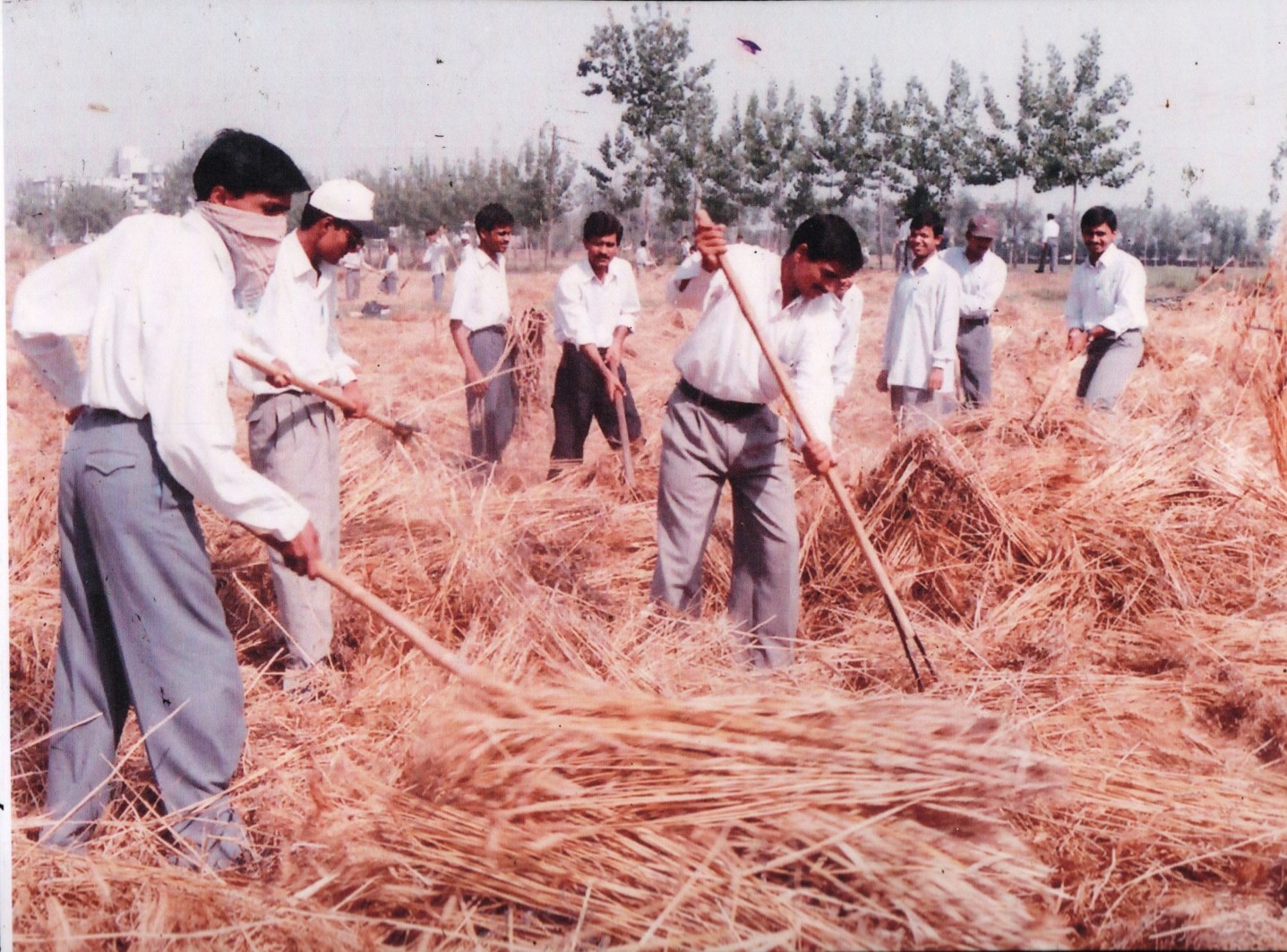
Turning of harvested wheat plants
The Education Policy of Dayalbagh Educational Institute, penned by Revered Dr. M. B. Lal Sahab, highlights the importance of Agriculture Operations as an essential element of the education system of the Institute. The Policy also emphasizes that the Head of the Institute, himself/ herself have an “active involvement in field work so as to infuse staff and students with enthusiasm”. Dayalbagh agriculture operates on scientific principles for which there is a RSSAF Scientific Advisory Committee.

Demonstration of Power Thresher
Agriculture Operations and Rural Development are mandatory core courses for students of all streams in DEI, with students participating in and getting hands-on training in all aspects of agriculture. Further, under NSS, students participate in various farm related and rural development activities. On Sundays, students in large numbers do field work. Students also participate in Gaushala maintenance, Dairy, herbal garden maintenance, biodiversity park development, and mushroom cultivation.

Demonstration of Disc Harrowing
There are plans to start precision farming to optimize utilization of manpower, irrigation water, and soil addendum, and to train students in the modern methods of cultivation. DEI has initiated agriculture education by starting undergraduate courses in B.Sc. Applied Botany and B. Voc. Agriculture Technology and an MBA programme in Agriculture Management.

Harvesting of Barseem
Activities in Progress

Energy conservation and reducing Diesel usage

Wheat, Gram, Mustard, Masoor, Baajra, Barseem and Barley are sown in Dayalbagh every year. Threshing is done to take out the seeds from these crops. The threshers are driven by 3-phase AC induction motors, with the system designed in DEI in collaboration with the Agriculture Department of Dayalbagh.


The electric distribution system for running the threshers with electric motors is designed in DEI with protections, metering, and alarms and appropriately sized cables to minimize voltage drop and losses. Three of the threshing machines run on solar power generated in DEI, reducing the electricity consumption from the Grid and potential downtime due to power failure. A dedicated solar power plant of 50kWp capacity is installed in the Dairy and Agriculture complex. A 20kW capacity Bio-gas plant is being commissioned and will be integrated through a Smart Micro Grid.

Ground water conservation through rain water harvesting and use of sewage treated water
Much of the agricultural irrigation in Dayalbagh is done through sewage treated water from the Sewage Treatment Plant (STP) situated at Dayalbagh. DEI helps Dayalbagh maintain the STP motors for pumping the treated water into canals for irrigation. A Short Messaging Service (SMS) based embedded system for remote monitoring and control of STP pumps has been designed and deployed by the students of DEI.


Integrated solar farming with remote controlled solar assisted micro-irrigation system for local energy use and better farm productivity
The concept of a solar agriculture farm is being developed in DEI. A novel sun-tracking structure has been developed that accommodates 50 solar modules at a minimum ground clearance of 12 feet, thereby facilitating multiple land use, viz. solar-agriculture farm where agriculture can be performed in the land beneath the solar modules. Combination of solar farming with agriculture increases the land yield. The cost of module support structure is compensated by the cost of the land salvaged. This will allow for a through the year solar crop even if the agricultural crop gets affected due to insufficient rains/ otherwise. These multiple land use models would allow large MW size solar plants to be installed near load centres and sub-stations, reducing the cost of grid infrastructure required when these solar power plants are installed on distant barren lands.


Mobile SPV plants for irrigation and other applications
Mobile SPV plants are being developed at DEI which are mounted on a trolley or a vehicle to be used for irrigation in rural areas where erratic or absent electric supply. The vehicle may be towed using a tractor with the SPV modules folded. Whenever required, the SPV modules can be unfolded (manually or motorized) to capture sun light and can power the irrigation pumps or for other uses. A multi-purpose variable frequency drive may be used for irrigation pumps as well as other applications. Typical sizes are 2 – 5 kWp capacity.

Proposed activities

Village Distributed Energy Resource (DER) Grid
Design and development of village DER Grid which would comprise of Irrigation Micro Grid and Residential Micro Grid with possible interoperability. Both micro grids have different load profiles and hence the separation.

Renewable energy solutions for completing the value chain for farmers located at remote places without access to reliable electricity
Extending the village DER grids/ designing efficient and economic stand-alone SPV plants to power cold storages, driers, winnowers, flour/ dal mills, husking machines etc. and complete the value chain for empowering the farmers at remote locations to grow crops of their choice and to get better agricultural land yields.

Data aggregation, data analytics, Machine Learning applications for Village micro grids
Precision agriculture involving sensors, embedded controllers and drip irrigation systems are going to be essential for future organic agriculture. Integrating the sensor data, weather logs and the solar data logs would be useful for efficient irrigation and precision farming. Modern Machine Learning techniques can be used to study and infer potential threats, economics and reliability of the system. Development of such handy software tools will help ensure efficient, economic and reliable operations of DER micro grids encompassing precision agriculture. Cloud storage servers would enable remote monitoring, analysis and control of village DER grids and agriculture.

Drones for precision farming application and surveillance
It is proposed to work on this area for localizing weeds and diseases, determining soil properties, detecting vegetative differences in farms associated with Dayalbagh. However, because of legal restrictions the drone payload should not exceed 5 kg.

Sustainable Development Solutions through Strategic Planning in Agriculture via Interactive Management Strategy
Idea Engineering, Fuzzy DELPHI, Option Field and Option Profile Methodologies along with Scenario Building Exercise and many other techniques of interactive management and system design to be utilized for solutions using Second Generation System Design Paradigm for the said sustainable agriculture initiatives. Such initiatives at sub-system level in Dayalbagh Farming System may be a starting point where deliverables could be used and closely monitored for further nurturing and modifications.

Hydraulic Ram (HYDRAM) for water lifting as a green irrigation initiative
The use of eco-friendly HYDRAM at different identified locations in the farm may reduce costs. A pilot study on use of HYDRAM is proposed.

Sprinkler Systems as Rain-fall Simulators
Besides, other promising areas viz. pico power generation, environmental protection practices, technology assisted organic farming, training and learning initiatives for farmers, students and stakeholders can also be explored and pursued.

Rural Development and Empowering Rural Women

DEI has embarked on a new educational pedagogy of engaging, educating, and improving skills of the rural women. In the remote tribal zones of Madhya Pradesh, ADyNaM (Agri Dairy Nano Processing of Multi-products) Foods has been set up. ADyNaM is a facility for processing of the agricultural and dairy-based raw produce to make secondary products. Women are trained on the production of pickles, chutney, amla candy, and squashes. Recently, a level-1 food testing laboratory has been setup to implement quality control, and to comply with the food safety standards.

Agriculture Education at DEI

In order that the experiential knowledge that Dayalbagh and DEI collectively possess benefits the society at large and contributes to the Nation, Faculty of Agriculture is proposed to be established by DEI after obtaining the necessary approvals and permissions. The Department of Botany got approvals from UGC to start two new courses namely B.Sc. (Hons) Applied Botany and B. Voc. Agriculture Technology from 2017. The Department of Management has initiated an MBA programme in Agriculture Management from 2017 session.

B. Voc. Agriculture Technology students sowing groundnut

Agriculture Operations in Dairying

RSS (Radhasoami Satsang Sabha) Gaushala in collaboration with DEI is transforming into a state-of-the-art Gaushala with the use of RFID, ICT tools, management software, sensors, and modern practices for precise management of nutrition, health, and breeding of cattle. The objective is to develop RSS Gaushala and DEI into a centre of excellence for precision Dairy Farming and Dairy Technology. The effort is to increase milk yield by improving nutrition, health, and breed of the cattle.

Breeding: Database management for maintaining all breeding records using precision Dairy farming software system. The database also records data on heat/ A.I./ calving/ milk yield/ treatment etc. are maintained.

Feeding: Feed planning originates from cultivation of our own crops. Extensive agricultural operations spread over 800 acres and wide range of crops balanced between crops for human and animal consumption is maintained. Each product of crop & its by-product is utilised. Emphasis is on quality & quantity of green fodder, which is the natural and cheapest source of protein. Silage preparation is also done to cater for the lean period.

Facilities Management: Wi-Fi network across the Gaushala provides ready access of information, which is critical for taking spot decisions. There is category & age group-wise housing of the herd. There is a platform weighing scale for monitoring the weight and growth of cattle (calves and heifers). Other B. Voc. Agriculture Technology students sowing groundnut facilities include a cattle bathing shower, similar to a car wash, where the water used for bathing feeds the buffalo pond and thereafter taken for cultivation of crops after getting enriched in urine & cow dung slurry. There is a cow brush parlour, with a sensor-based scrubber and timer. The rotatory movement with brushes relaxes the cows during idle time by reducing itching and increasing blood circulation. The eco-friendly sheds with thatched roofing maintain temperature during summers & winters. Other activities to reduce cattle stress:
  • Playing of devotional music during milking
  • Giving names to each cow & conversing with them using their names
  • Access to clean & fresh drinking water at all times
  • Improving ventilation in sheds by lowering of brick walls
  • Installation of fans in high yielder shed
  • Using thatched roofing in new sheds
  • Khus-chick curtains with drip system and misting are being experimented to reduce the heat stress of the cattle


Dairy Technology Activities in Dayalbagh

Cupid is a logo of REI Dairy products. REI Dairy has been judged as Asia’s best and world’s second-best dairy. On 8th January 1934, Cupid Butter landed in United States after travelling 10,000 miles for 45 days over land and sea without refrigeration and scored 91 points as compared with the score of 92 points scored by the best fresh butter produced in America. Several dignitaries, who visited REI Dairy whole heartedly praised its efficient and professional operations and the quality of its products. In 1935, during his visit to Dayalbagh, Lord Willingdon, Viceroy and Governor General of India, was pleased to call it “the most efficient” Dairy seen by him in many years. Cupid butter was awarded Certificate of Merit in the All India Exhibition of Arts and Industries in Punjab. In 1938, a six months Certificate course on practical training in Modern Dairying and Livestock Management was started at REI Dairy. In 1943, the efficiency of the dairy received a further testimony from the American Forces in Agra, when during 1943-45, they decided to get all their supplies of milk from this Dairy in preference to the Military Dairy in Agra.

Dairy Education at DEI

In 1994, the Dairy became a part of DEI, and work experience training in Dairy products was initiated. In 2015, DEI became the first Deen Dayal Upadhyay Kaushal Kendra in the country with Vocational Programmes in Dairy Technology. Under Kaushal Kendra, B. Voc., M. Voc. and Ph.D. Programmes in Dairy Technology have been approved by UGC. From the 2015-16 session, B. Voc. (Dairy Technology) was launched.

An experimental mini Dairy plant has been setup for providing in-house training to the students. Using this facility, students produce a variety of nutritional value-added dairy products, which not only caters to the needs of the local community and DEI on non-commercial basis, but also gives them practical exposure to entrepreneurship in Dairy Sector. DEI is privileged to have the first student run mini dairy plant in Northern India with FSSAI License, HACCP certification, export permit from Export Inspection Agency, Govt. of India, and commercial permit from US Department of Agriculture for the export of flavoured milk and butter.

The emphasis of these programmes is on entrepreneurship. The B. Voc. (Dairy Technology) has also been launched at the DEI ICT Centre at Amritsar. In December 2016, under Pradhan Mantri Kaushal Vikas Yojana for Technical Institutions through AICTE, a certificate course on Dairy Equipment Operator has been launched. Mini Dairy plants are also being set up in DEI ICT Centres at Amritsar, Timarni and Rajaborari. The objective is to reach out to other regions including remote parts of the country, and provide quality vocational programmes, and contribute to the mission of skilling, entrepreneurship in a scaled up and accelerated mode.

Friday, 1 September 2017

Notes from DEI IEEE R10 Humanitarian Technology Conference

The Dayalbagh Way of Life is not fixed at some point of time in the past. It is evolving with immense innovation, with Dayalbagh and its institutions imbibing and contributing technology to make human life on this planet more sustainable. The innovation cycle followed by Dayalbagh is evolutionary and not revolutionary, so that we can take each person along.

In the words of Revered Prof. Prem Saran Satsangi, from his book, Management of Rural Energy Systems, published in 1983, “…in the service of The Last, The Least, The Lowest, and the Lost Among Mankind”. So, we are looking at implementation of technology that furthers the Humanitarian cause.

In December 2016, Dayalbagh Educational Institute hosted and conducted the IEEE Region 10 Humanitarian Technology Conference (HTC). IEEE, as many of you may be aware is the world's largest technical professional organization dedicated to advancing technology for the benefit of humanity, with ~450,000 IEEE members in over 160 countries.

The focus of this Conference was on Sigma Six Q & Smart Villages: making sustainability a way of life. The scope of conference papers included, the application/innovation of technology to improve quality in the following areas: Energy, Education Systems, Environment Systems, Healthcare, Agriculture & Dairy, Smart Village and Women Empowerment & Security.

Here is a summary of the topics of the Conference Speakers, speakers outside of DEI and IEEE...

On Day 1, in the Theme Session, the first speaker was Padma Bhushan Dr. V K Saraswat, Former Secretary Defence R&D, Member NITI Aayog.

Dr. Vijay Kumar Saraswat is an Indian scientist who formerly served as the Director General of the Defence Research and Development Organisation (DRDO) and the Chief Scientific Advisor to the Indian Minister of Defence. He is presently member of NITI Aayog i.e. the organization that replaced the Planning Commission of India and Chancellor of Jawaharlal Nehru University.

Dr. Saraswat kick-started the Theme Session on Gandhiji's quote on our working for a Planet that we will not see. He walked us through the past, the damages caused by our advancement, like land-fills, impact on rivers, depletion of non-renewable sources, loss of habitat and other staggering challenges like global health, food, water, rising temperatures, species extinction, coral bleaching and mortality, coastal flooding and reconfiguration of coast lines, droughts, disease vectors. He took us through disruptions like Global Urbanization, accelerating climate change, aging world, greater global connections. He gave us a glimpse and road map for the future, developing and deploying transformative and enabling technologies and the necessary and desirable transformations for sustainability and ushering in a human centric era.


Dr. Anoop Srivastava, IG, Indian Railways, presented his views on “Sigma Six Q practices in Dayalbagh, a smart eco-village”.


Abstract from his talk…

Establishment of Dayalbagh has a unique place in the history of India. The metaphorical foundation stone of Dayalbagh was laid on 15th Jan 1915 in the form of plantation of a mulberry tree by its August Founder, Sir Anand Swarup Sahab, which heralded conversion of a sandy, barren land into a lively green-belt created and maintained by the settlement of like-minded people. At the time when planned development of the kind we know today was rare, it was only a divine plan that could envisage enrichment of the colony with Sigma Six Q practices in the days to come.


A term coined by Revered Prof. Prem Saran Satsangi, to describe the Dayalbagh way of life, Sigma Six Q refers to the six salient qualities that are inherent in the dynamics of this eco village. Summation of these qualities, viz., Innovation, Air Quality, Water Quality, Health and Education, Agriculture and Dairy, and Values- such as duty, beauty, humility courage, temperance, wisdom, loyalty and justice-leads to synergistically enhanced impact on the system. Dr. Srivastava’s talk covered the highlights of Sigma Six Q Model as practised in Dayalbagh and its importance for sustainable growth.

The third speaker in the Theme Session was Padma Shri Dr. Ashok Gulati, India’s top Agricultural Economist whose topic was “Growing the Third Crop – Doubling farmers’ incomes by harvesting solar power”.


Abstract from his talk…

Father of the Nation Mahatma Gandhi said, “Poverty is the worst form of violence” and also considered “Science without Humanity” as a spiritual sin. He suggested the use of technology to alleviate poverty and thus uplift humanity.

Government of India has set an ambitious target of 100,000 MW of solar power capacity to be achieved by 2022. Interestingly, Government of India has also set another ambitious target of doubling farmers' incomes by 2022!

The uppermost question in everyone's mind is: can these targets be achieved by 2022?

This is particularly so when the current solar power capacity in the country touched 8000 MW by July end, 2016, and no country in the world has such an ambitious target as India has set out for 2022.  On farmers' real incomes, the compound annual growth rate (CAGR) in the recent past (FY 2003 to FY 2013) has been a mere 3.5%; and doubling these incomes by 2022 would mean increasing this CAGR from 3.5% to more than 12%. 

Our global review suggests that costs of solar power have come down across the world, by about 70 per cent since 2010-11. Most projects have been executed as ground mounted utilities or as rooftop solar. But we submit an innovative policy- that saves on land as well as help to augment farmers’ incomes. A significant progress can be made towards achievement of both of these goals of Government of India, provided both are conceived and implemented in unison, a sort of marrying each other, with innovative policies- like the guaranteed feed-in-tariffs (FIT) for solar power generated on farmers' fields- to back this alliance. Solar power can be used all along the agriculture value chain- as a third crop for farmer fields, for solar powered irrigation systems, for cold storage's and processing industries like dehydration. A true model of Competitiveness with Inclusiveness, this can be Scaled up in a Sustainable manner (CISS Model). This will also help to reduce power subsidies of state electricity boards (SEBs), wherever solar power can substitute existing connections.

The only thing to be seen is how to raise advance capital funds, how to organize farmers on these lines, how to convince the Discoms for guaranteed feed-in-tariffs, and how long it is persevered till the goals are reached!

On Day 2, we had a Special Session on Science of Consciousness (more on this in a separate post - a small summary here)

Prof. Vishal Sahni presented a paper on “Innovative (Superintelligence with Spiritual-Quality and Value Based Control-) Graph Theoretic Quantum System Modelling (IGTQSM)”.

This was followed by a session by Dr. Anirban Bandyopadhyay on “Consciousness is music of the primes”.

Dr. Dayal Pyari Srivastava presented her research on “Scientific Epistemology and the Phenomenology of Consciousness: Looking for Correspondence between them using SQUID based MEG Device”.

The session ended with Dr. Bani Dayal Dhir giving an overview of (i-c-n-c-) TALL, “(iNFORMATION-cOMMUNICATION-nEURO-cOGNITIVE-) Technologies Assisted Language Lab at Dayalbagh Educational Institute.


On Day 3, we had Mr. Jayant Krishna, COO, National Skill Development Corporation, whose talk was on “Reaping the Demographic Dividend through Skilling India, leveraging technology for Skill delivery”.

Abstract from his talk...


Education is the key to sustainable development. It is the creation, adaptation and sharing of knowledge, skills and values that is essential to development – both at the individual level as well as at the macro level. Right to Education is not only an excellent catalyst for social change and justice, it helps us understand and realise our other rights – economic, social and cultural.

Education combined with skills form the driving forces of economic growth and social development for any country. With the rise of the knowledge society and growth of digital media, the goal posts keep changing for what might constitute as basic functional literacy.

India has developed a national higher education system that offers multiple choices and pathways to acquire a variety of skills. With nearly 700 universities and more than 35,000 affiliated colleges enrolling more than 20 million students. In contrast to the ageing population of the western world, India has a unique 20–25 years window of opportunity called the “demographic dividend”. This demographic dividend presents a tremendous opportunity for India to become a global economic leader. It is expected that India will have more than 700 million people in the working population by 2022, with 12 million people expected to join the workforce each year. This talent pool needs to be adequately skilled.


In order to prevent demographic dividend from turning into a demographic disaster, the government has taken several steps to empower people at the grass root level and help them acquire skills in order to earn a better livelihood. In November 2014, the government also formed the Ministry of Skill Development and Entrepreneurship, which will catalyse skill development initiatives across the country.  The single biggest reform is the amendment to the archaic Apprenticeship Act, which now make it easier for companies to hire and train apprentices. Apprenticeship has been a successful model of skilling youth in countries all over the world. This reform alone can increase the number of apprenticeships in India from the current 2.4 lakh to 30 lakh a year. The motivation through Pradhan Mantri Kaushal Vikas Yojana (PMKVY) has driven more than 20 lakh candidates to get skilled and certified in the last one year. The journey has just started; the path has just been laid to lead India into an era of becoming the skills capital of the World. 

Editor’s Note: Dayalbagh Educational Institute is one of the top Institutes for Vocational Education.

The Valedictory Speaker was Dr. Ajoy K Bhattacharya, MD, National Green Highway Mission who talked about his mission, Carbon Sequestration – My Way is the Highway

Abstract from his talk...

Dr. Bhattacharya talked about developing eco-friendly National Highways for Sustainable Environment & Inclusive Growth, with objectives of develop a systematic framework for Integrated Green Corridor Development along National Highways, Build resilient ecosystem in the form of “Green Corridors” along National Highways for Combating global warming and climate change effects, Optimum GHG sequestration, conservation of native species of the region, develop unique green corridors with aesthetic appeal, reduce the impacts of air, noise pollution and dust, reduce soil erosion at embankment slopes, reduce the effects of wind and incoming UV radiation.

Additionally, there were two special tracks and a Hackathon.

Special Track 1: Women in Engineering track


The theme of the session was, “Women Empowerment to break barriers and lead the smart world”.

The chief guest was Ms. Sneh Bijlani, Treasurer of Dayalbagh Educational Institute. She captivated the audience by narrating her own experiences in achieving top level positions and the hardships one has to face as a woman and how she overcame these with perseverance.


Special Track 2: Young Professionals Track

This track was focused on “The Digital Revolution and its implications in everyday lifeThe speakers view was that with the dawn of digital technologies, we are in the early stages of significant changes leading us into the age of “Systems”. The machine age which has industrial revolution as its counterpart is now giving way to “Systems Age” having automation and AI (Artificial Intelligence) as its technological counterparts. “The Rise of the Robots” and “Machine Learning” technologies are will cause unemployment so much so in about thirty years, half of world population will be out of jobs according to a report. As one computer scientist put it, "We are approaching a time when machines will be able to outperform humans at almost any task. I believe that society needs to confront this question before it is upon us: if machines are capable of doing almost any work humans can do, what will humans do?” In the years to come life could be absolute leisure with no work and this could be death knell for human survival, particularly if the developing technology is not kept as a good servant. These sentiments were echoed when Stephan Hawking had said that AI, if left unchecked, "could spell the end of the human race". Elon Musk (Tesla Inc.) also sounded that future advancements in AI could be akin to "we are summoning the demon".

In order to understand the revolution, we are experiencing we need to look more closely at the concepts, ideas and philosophies that are shaping the evolving world view. This calls for a shift in our thinking that is required as the world unfolds around us in this “Systems Age”. The globalized world is a giant social system, interdependent and interconnected (hyper connected). So, our approaches to understand and solve problems cannot be based on mechanistic view of the world, hitherto followed. If we are complacent and maintain status quo on how we think and act in a reactive mode, there will be “degradation of our quality of life, if not our standard of living”. As we move into the systems age, we need to supplement our high-tech abilities, with thinking abilities that are high concept (systemic ideas, detecting patterns, creativity) and high touch (empathize, purpose and meaning).

And in parallel to all these sessions we had the fun-filled Hackathon

Typically, these conferences tend to be academic in nature, with limited industry and student interaction. In this conference, a hackathon/makethon was launched, as it offers the opportunity to bring together the best of:


  • Academia – latest technology and research ideas. Bringing theoretical concepts to real world through building prototypes.
  • Industry – state of the art engineering and design concepts, science in action. A platform where the academic and student community provides new ideas and new talent to fuel the next generation of their products and service offerings.
  • Students – motivated, enthusiastic next generation leaders of technology. This event offers access to cutting edge technology, which helps them gain hands on technical skills in line with industry trends.


There were over 150 registrations and 70 final participants. It represented how the next generation of student members will be indispensable in our search for sustainable solutions to some of the major, existential problems that lie before us – climate change, unprecedented pollution, population growth, diseases and epidemics, and natural disasters.


The winning projects were:

Efficient Water Management
Water is a big problem: Today, India ranks second worldwide in farm output. Agriculture and allied sectors like forestry and fisheries accounted for 13.7% of the GDP (gross domestic product) in 2013, about 50% of the workforce. We have come up with an Efficient Water supply management System in which adequate amount of water will be used, based on the crop, time during the crop cycle and in a drip irrigation way and not flood. 

Real Time Automatic Plougher and Sower (RAPS)
Nowadays farmers face problem in getting adequate labour. This system will reduce labour work of farmers and help in increasing the preciseness in seed sowing system. The system is a robotic vehicle that facilitates ploughing fields and sowing seeds without human intervention.

Park IT
Majority of the Traffic problem is due to improper parking system.  In India 25% Accidents are due to improper parking in Metro Cities. This prototype consists of a mobile app and hardware unit that helps user book the parking slot in real time. This system will solve daily life parking problem faced by people in Metro cities. This system will allow you to register your vehicle number in the parking system through mobile app. The system will also notify you about the available parking space nearby.

Sound of Silence
Speech impaired people always face difficulty in communicating and socializing with people around them. The system recognizes gestures of speech impaired people and convert them into sound signals. Hence this system helps speech impaired people to communicate effectively with the people around them. This will overall create a change in their day to day life.

Any Time Medicine (ATM)
We come across long queues around medical shops and at times there is an early shutdown of medical shops. This causes inconvenience to public who require medicines in urgency. The project aims at providing medicine anytime and anywhere. This system helps to get the medicine you require in case of emergency. Tap on the medicine of your choice and you can pay by scanning QR code. In case the medicine is not available a message will be displayed to convey the same.

Smart cycle sharing system
Going from one place to another in big educational, corporate and community campus is very time consuming. The density of vehicles is exponentially rising not only causing health related issues, but also rising environmental concerns.  The complete system consists of GPS based tracking device that helps in real time tracking of bicycle. The user has an option to pre-book the cycle through mobile app.

That’s it for now.

Thanks to Prof. Bhagwan Das for his inputs and help. We will take you through further details of some of the Plenary talks in later posts.

The above post is by Anurag Singh, the Sigma Six Q Blog Editor.

Saturday, 22 July 2017

Reuse of Water


"All the water that will ever be is, right now."
National Geographic, October 1993

In an earlier post, we gave you global water statistics. Let me quote these again.1
  1. 2.53% of global water is fresh water (Glaciers, Ground ice, Freshwater lakes, Swamps, River flows, Biological water, atmospheric water)
  2. 1.7% of global water is in permanent ice/ glaciers (and depleting).
  3. Only 0.76% of global water is fresh water ground water (and depleting).
  4. Only 0.007% of global water is in fresh water lakes (and depleting).
  5. Only 0.0002% of global water is in river flows (and depleting as the sources are drying up).

Water availability from river flows for home usage, agriculture and industry is no longer sufficient. There are already indications of water wars between nations and water riots in our localities.

To ensure water availability for our burgeoning population we need to ensure
  • that the sources of river water are replenished and preserved
  • that we can recharge ground water sources
  • that we can recharge our fresh water lakes


Further, if we recycle water it increases availability substantially (something that nature anyway does through the water cycle). Recycled water is purified and treated wastewater so it can be used again for new purposes, primarily non-drinking. Our post this week is on

"Water Reuse at Dayalbagh".


This post is by Dr. Satya Prakash, Sarpanch of Prem Nagar Mohalla at Dayalbagh and previously Head of Chemistry at Dayalbagh Educational Institute and Scientist Leader of Nuclear Chemistry at Bhabha Atomic Research Center with inputs from Mr. B S Ahuja, TFA, Radhasoami Satsang Sabha.

Regards,
Anurag

Dr. Satya Prakash writes...

Waste water from domestic use in Dayalbagh falls into two categories. One arises from kitchens, bathing, washing clothes and other household chores. This flows into a network of drains that discharges into open ponds and is used for irrigation and ground water recharge.


The second category of waste water is from the sewers of toilets of each of the houses and this gets collected into septic tanks behind every house. In these septic tanks due to bacterial degradation the BOD (Biological Oxygen Demand which is a measure of organic content) is reduced by 60%. The overflow of effluent from septic tanks is led through the sewerage system to a common collection tank. From here the effluent is pumped into an oxidation pond where BOD decreases to nearly 10 ppm as the water is further treated. Such independent processing system exists for each Mohalla of Dayalbagh. The treated water is used to irrigate land for agricultural produce.


In addition, effluents collected from a large area within northern part of Agra are sent to a Sewage Treatment Plant (STP) located at Jaganpur, about 5 KM north of the Dayalbagh Colony. A 14 MLD (million litre per day) STP was commissioned in 2011 under an agreement between Agra Nagar Nigam and Dayalbagh, where Dayalbagh provided land for setup of the STP at a nominal cost. The plant provides 14 MLD (Million Litre per day) of treated effluent for the Agricultural Farms of Dayalbagh. Excess water from STP is released to the River Yamuna for downstream usage.

The whole process of recycling of water ensures lesser water demand from the Yamuna river and also ensures that the Yamuna does not get polluted through untreated effluents being discharged into it.

  1. Igor Shiklomanov's chapter "World fresh water resources" in Peter H. Gleick (editor), 1993, Water in Crisis: A Guide to the World's Fresh Water Resources (Oxford University Press, New York).


Saturday, 10 June 2017

Sigma Six Q: Does Planet Earth have a Future?

Your response to our Sigma Six Q blog, the Facebook and the Twitter posts has been overwhelming. Though it has only been a few weeks, many of our Facebook posts now reach an audience of thirty-forty thousand people and our twitter posts leave fifteen thousand impressions. This is a great start. This is our Way of Life that we are modeling and documenting. 
As our social media community multiplies and expands, we expect these posts to reach a million plus people in the short term and have a large positive effect in this world gasping for breath.

Recently, theoretical physicist Stephen Hawking asserted that humans need to colonize a new planet within the next 100 years for the survival of our species. If we assume for a second that given the direction in which our world is hurtling (and without divine intervention) this is true, then there are two possible options that we have today:
  1. We can behave like many a selfish individuals or communities or for that matter nations and remain content in our current non-sustainable all consuming ways as we would anyways be dead in the next hundred years!
  2. Or we can align our thinking and energies towards a Sustainable and happier Sigma Six Q Dayalbagh Way of Life to make this world a better place for generations to come.

The choice is ours to make individually and together as a community, as a nation and as inhabitants of this planet.

In the previous posts, we have introduced the Sigma Six Q model and covered the Six Qualities for a Sustainable Way of Life.

The Six Qualities are:
  1. Innovation: Changing, altering, evolving, progressing and adopting near state of the art processes and technologies for better outputs and outcomes.
  2. Air Quality: Maintaining high Quality of Air, keeping it crisp and clean with minimal pollutants, greener surroundings, limiting increase of green-house gases and tending to a zero-carbon footprint.
  3. Water Quality: Providing high quality drinkable water for human and animal consumption, quality water for agriculture, ensuring water conservation, harvesting and recycling.
  4. Education and Healthcare: Making Education affordable, accessible and comprehensive leading to the evolution of a complete man with integration of intellectual abilities, physical strength, emotional stability and ethical values. Making Healthcare affordable, accessible and preventive.
  5. Agriculture and Dairying: Continuing with the Green and White revolution and further innovating to make it sustainable.
  6. Values: Application and practice of abstract values in our way of life; values of Duty, Beauty, Humility, Courage, Temperance, Wisdom, Loyalty and Justice imprinted early. Values of democracy, secularism and humanism leading to a lifestyle of Better Worldliness.

As stated by Revered Prof. Prem Saran Satsangi, “Sigma means that all these aspects or components have interaction amongst themselves and the cumulative effect of all these is many times more than their individual effect.”


The four Qualities of Air Quality, Water Quality, Education and Healthcare, Agriculture and Dairying need to necessarily sit on a bedrock of Innovation and then the five Qualities get bound together by Values.

This completes our introduction of the Sigma Six Q model. We will now delve into various facets of these Qualities and their implementation in subsequent blogs.

We want to most humbly thank Revered Prof. Prem Saran Satsangi for the Sigma Six Q Sustainability model and for providing us with an opportunity to blog this model to you all.

Look forward to your stories, your views, your implementations and experience with these Six Qualities. Drop us a mail at sigmasixq@gmail.com.

You can follow us on Facebook (www.facebook.com/sigmasixq) and/ or on twitter (https://twitter.com/SigmaSixQ). You can also subscribe to our posts via email (link on the right). You can like our posts on Facebook and Twitter and share them further with your friends/ followers.

The above post is by Anurag Singh, Editor of the Sigma Six Q Blogs.

References:
  1. “The Dayalbagh Herald” dated Tuesday, June 21st, 2016