Showing posts with label Renewable. Show all posts

Sunday, 14 April 2019

Dayalbagh: An Eco-Village

A Wikipedia article defines Eco-Villages as "... traditional or intentional community with the goal of becoming more socially, culturally, economically, and ecologically sustainable. It is consciously designed through locally owned, participatory processes to regenerate and restore its social and natural environments".

A tree-laden road within Dayalbagh

The article further states, "Eco-villagers are united by shared ecological, social-economic and cultural-spiritual values. Concretely, eco-villagers seek alternatives to ecologically destructive electrical, water, transportation, and waste-treatment systems, as well as the larger social systems that mirror and support them. Many see the breakdown of traditional forms of community, wasteful consumerist lifestyles, the destruction of natural habitat, urban sprawl, factory farming, and over-reliance on fossil fuels as trends that must be changed to avert ecological disaster and create richer and more fulfilling ways of life".


And what better example of an eco-village than Dayalbagh. Dayalbagh is more like a small town, with 2,500+ permanent residents, the population increasing manifold during Basant, Holi and Bhandara weeks with the influx of pilgrims. Additionally, its way of life thinking and practices influence the communities around Dayalbagh.

Our post below is on practices followed in Dayalbagh, the eco-village.

Go green,
Anurag
Dayalbagh, an eco-village

Eco-villages are urban or rural communities of people who strive to integrate a supportive social environment with a low-impact way of life. To achieve this, they integrate various aspects of ecological design, permaculture, ecological building, green production, alternative energy, community building practices, and much more. Eco-villages are living models of sustainability. They represent an effective, accessible way to combat the degradation of our social, ecological, and spiritual environments.

Dayalbagh is an eco-village/city, quiet and peaceful with a largely self-sustaining agricultural production, water harvesting and increasing use of renewable solar energy.


Prem Nagar, a Mohalla in Dayalbagh

Education, agriculture and industries prosper in harmonious and ecologically sustainable manner. Dayalbagh is greener and more sustainable since its foundation in 1915, even though its population has increased. Dayalbagh’s eco-development, presents an admirable combination of material and spiritual development. It represents a classic case of self-sustained eco-friendly existence of human settlement in close harmony with the nature.

Activities

Self-Governance
Civic affairs are managed through a committee of elected representatives under the overall supervision and control of a primary committee. The eco-village is divided into mohallas, with each having a Sarpanch and Panches for different activities of the mohallas.  Honorary services are imparted by the residents of the village.

Water and Electricity Supply
Water supply to the village is provided through tube wells. To sustain ground water levels, rain water harvesting schemes have been implemented. For electricity needs the village bulk purchases are made from M/S Torrent Power Ltd. To ensure uninterrupted electricity supply, the village also has its own back up generation facility. There is also an increasing use of solar power. Solar powered lights have been installed in open spaces within and outside the village in selected areas and also for street lighting. Solar power units are installed in all institutional buildings. Moreover, to reduce power consumption, LED lights are used to the maximum possible extent.


Renewable Power at Dayalbagh


Renewable Power in Cooking Applications

Community Kitchen
Bhandar Ghar is the Rasoi (Kitchen) which prepares lunch and dinner for the residents of the Dayalbagh colonies and for the visitors.


The raw material like wheat, rice, lentils, mustard oil, vegetables including potatoes and onions are grown and produced in the Dayalbagh fields with selfless service of the Dayalbagh Residents and Visitors. The Bhandar Ghar has minimal number of regular staff and the major part of the operation is supported by teams of volunteers in the age group of 18 to 90 yrs.


Bhandar Ghar: The Community Kitchen

Sewage and Garbage Disposal
There is a regular sewage system and garbage disposal. Garbage disposal includes segregation of biodegradable (kitchen waste) and non-biodegradable waste at each house of the village. There are well established treatment facilities for effluents. Treated water is used for irrigation.


Aeration Ponds

Security and Surveillance
Safety and Security of the colony is maintained by day and night patrolling (pehra) in shifts by the residents. Community policing through watch and ward department is performed for safeguarding public property. Most recently, CCTV cameras have been installed at various locations in the village which are also monitored by the residents.

The streets are patrolled by Residents at Night

Educational Hub
Education from the pre-nursery to the Ph.D. level and beyond is imparted through DEI. Additionally, the village has a School of Languages to teach regional and foreign languages, a School of Art and Culture to provide training in music, dance and handicrafts, a Tailoring school for empowerment of women from the weaker sections of the society, an Indian Music Training Center and a School of Dress Designing and Interior Decoration. A Day Boarding School has also been set up to provide special tutorial teaching to the students of under privileged families who do not have adequate facilities at home.

Primary School in Dayalbagh

Economical Agriculture and Farming
The topography of the land was initially dominated by ravines, low mounds, patches of rocks and stones and alkaline soil, sand dunes and patches of reeds and weeds, lying as waste-land. Since 1942 under the ‘Grow more food’ campaign, the uneven and unproductive barren lands have gradually been made suitable for cultivation. Today, in the Dayalbagh area, there are nearly 1531 acres of agricultural farms where cereals, pulses, oil seeds, vegetables, fruits, cash crops (potato, sugarcane, etc.) and fodder are cultivated. Farming activities are eco-friendly and based on organic farming techniques that helps in soil conservation and enrichment.


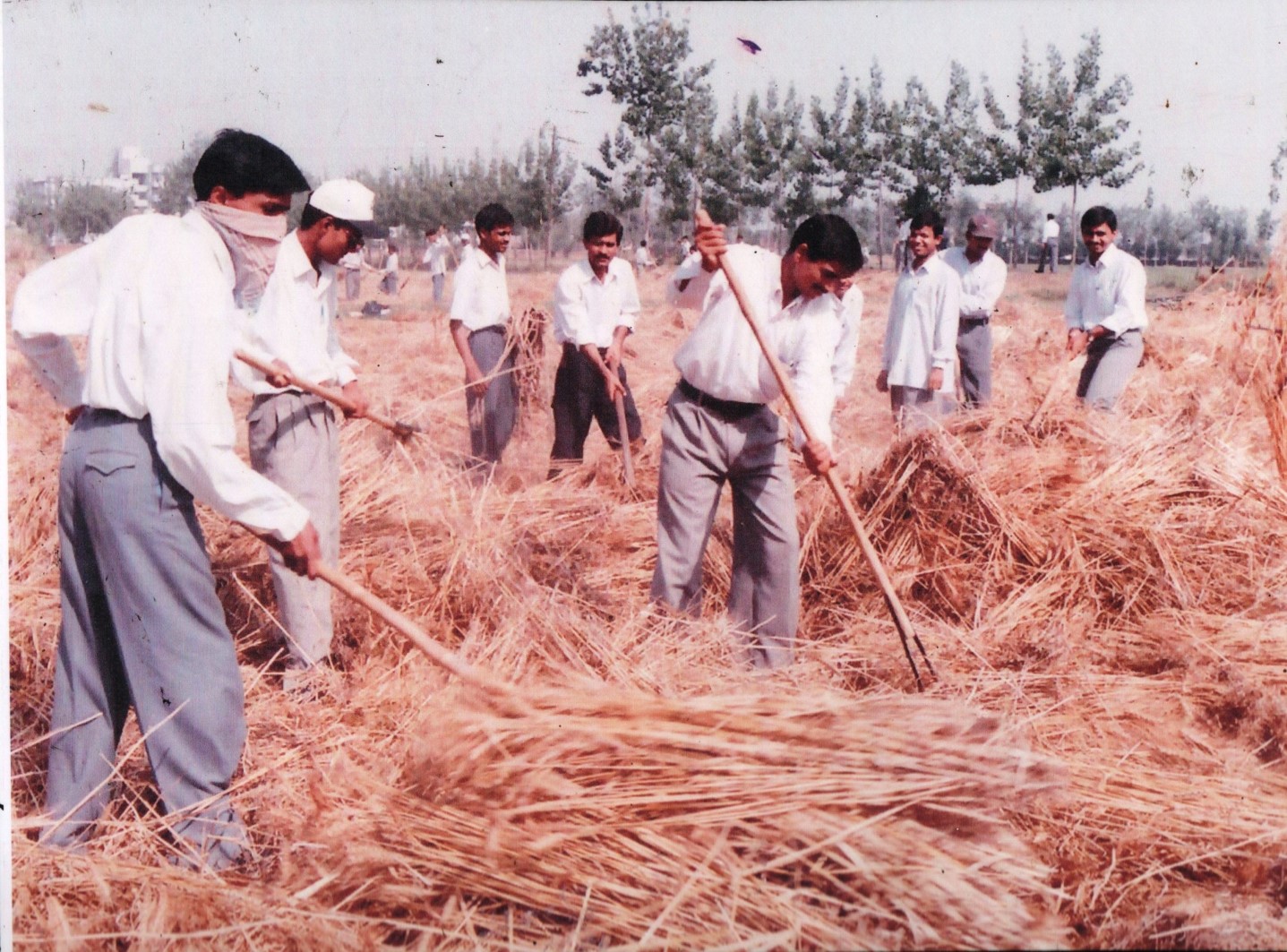
Residents, Students and Pilgrims performing Agriculture work

Both traditional and modern agricultural practices are adopted here. Agriculture is supplemented by Gaushala wastes for meeting out its manure requirement. Cooperative efforts are made in performing different agricultural activities and no chemical substances like insecticides, fungicides, weedicides or chemical fertilizers are used. The agricultural produce of Dayalbagh is sufficient to meet the requirement of the residents and the pilgrims who come for short visits.

Fodder for the Cattle at Dayalbagh Dairy

Horticulture
Horticultural activities are practiced in Dayalbagh: there are orchards of mango, Jack fruit (Artocarpus spp.), Guava (Psidium) and various citrus species along with many other fruit trees to provide large canopy cover as well as a supply of some fruit.
Healthy Diet: Horticulture - Kinnow Plantation

Cattle Yard and Dairy
Dayalbagh has its own cattle yard with over 800 head of cattle which fulfills the milk requirement of the residents. Its fodder requirements are met internally round the year. Animal waste is recycled and used as manure in fields. The dairy produces pasteurized milk and several milk products employing the most advanced techniques. These products are also sent outside the country.


Retirement Home for Older Cattle

Green Belt
The construction of green-belts has been an important feature of land use planning in Dayalbagh. These are in the form of a tree corridor all along the Yamuna river bank, in agricultural and farming areas, and, areas earmarked for timber plantation.

Ecology and Biodiversity in the Green Belt
The western part of Dayalbagh eco-village has triangular patches of dense plantations reaching the bank of the Yamuna. While most of the uneven land has been leveled and converted into well-formed green fields, in some areas the uneven topography remains. This area is being used for cultivating crops such as taramira, growing trees such as amla and some timber plantation. An orchard of citrus fruits has also been established in this area.

Two species, Prosopis and Acacia are also maintained in the region.

Waste Treatment: Composting
In Dayalbagh, domestic waste is mostly organic, and each member of the population produces approximately 200 kg of organic solid waste per year. Other sources include garden litter and wastes from dairy sheds, etc. The residents segregate the wastes into biodegradable and non-biodegradable material which is collected: pooled biodegradable wastes are directly sent to composting sites while non-biodegradable materials are sent to recycling points.

Transport
The most popular modes of transport in the area are bicycles and cycle rickshaws; efforts are on restrict the number of fossil-fuel driven vehicles in this area to reduce congestion and to accompanying noise and air pollution. Within the Dayalbagh colony, transport is provided by electric vehicles and rickshaws.


Electric Vehicle, ready to ferry Residents and Visitors

Dayalbagh has grown into a center of high spiritual, academic and moral values and has provided solace, satisfaction, peace and enlightenment to its residents and visitors who come in thousands seeking inner and outer peace.

Sunday, 13 January 2019

Agriculture and Dairy Education

Revered Prof. Prem Saran Satsangi, on 6th of July 2014, while explaining the Dayalbagh Way of Life and Agriculture and Dairying forming the fifth component of the Sigma Six Q model, stated, “Agriculture gives us opportunity to do selfless service and it is recognized in the country that there is still great opportunity to develop agriculture. It won’t be enough if we give emphasis to industry only. If we want to reach our progress in the country to all sections of people in Society, it is necessary to introduce entrepreneurship, innovation etc. in agriculture also for realizing desired progress and development”.

Agriculture Operations is an essential element of the education system at the Dayalbagh Educational Institute (DEI). In the article below, Prof. Prem Kumar Dantu takes us through the 
‘Agriculture and Dairy Education at DEI’.

Eat well,
Anurag

Prof. Dantu writes...

Agriculture operation in Dayalbagh has a hundred-year history. It is a need-based, sustainable, eco-friendly, and a scientific endeavour. Dayalbagh is self-sufficient in food for its residents and pilgrims and produces enough green fodder and bhusa (straw) for its Gaushala (Cowshed). In addition, it produces several fruits and herbs for Dayalbagh Pharmacy. Most of the agriculture operations are performed on a voluntary basis. This voluntary seva (selfless service) based agriculture model, on a smaller scale, is also practiced in Dayalbagh colonies in other parts of the country, such as Rajaborari and Timarni in M.P., Murar in Bihar, MTV Puram in Tamil Nadu, and Kakinada and Vishakapatnam in Andhra Pradesh. Hundreds of volunteers work together in the farms, every morning and evening irrespective of their age, gender, class, caste, and status.

Turning of harvested wheat plants
The Education Policy of Dayalbagh Educational Institute, penned by Revered Dr. M. B. Lal Sahab, highlights the importance of Agriculture Operations as an essential element of the education system of the Institute. The Policy also emphasizes that the Head of the Institute, himself/ herself have an “active involvement in field work so as to infuse staff and students with enthusiasm”. Dayalbagh agriculture operates on scientific principles for which there is a RSSAF Scientific Advisory Committee.

Demonstration of Power Thresher
Agriculture Operations and Rural Development are mandatory core courses for students of all streams in DEI, with students participating in and getting hands-on training in all aspects of agriculture. Further, under NSS, students participate in various farm related and rural development activities. On Sundays, students in large numbers do field work. Students also participate in Gaushala maintenance, Dairy, herbal garden maintenance, biodiversity park development, and mushroom cultivation.

Demonstration of Disc Harrowing
There are plans to start precision farming to optimize utilization of manpower, irrigation water, and soil addendum, and to train students in the modern methods of cultivation. DEI has initiated agriculture education by starting undergraduate courses in B.Sc. Applied Botany and B. Voc. Agriculture Technology and an MBA programme in Agriculture Management.

Harvesting of Barseem
Activities in Progress

Energy conservation and reducing Diesel usage

Wheat, Gram, Mustard, Masoor, Baajra, Barseem and Barley are sown in Dayalbagh every year. Threshing is done to take out the seeds from these crops. The threshers are driven by 3-phase AC induction motors, with the system designed in DEI in collaboration with the Agriculture Department of Dayalbagh.


The electric distribution system for running the threshers with electric motors is designed in DEI with protections, metering, and alarms and appropriately sized cables to minimize voltage drop and losses. Three of the threshing machines run on solar power generated in DEI, reducing the electricity consumption from the Grid and potential downtime due to power failure. A dedicated solar power plant of 50kWp capacity is installed in the Dairy and Agriculture complex. A 20kW capacity Bio-gas plant is being commissioned and will be integrated through a Smart Micro Grid.

Ground water conservation through rain water harvesting and use of sewage treated water
Much of the agricultural irrigation in Dayalbagh is done through sewage treated water from the Sewage Treatment Plant (STP) situated at Dayalbagh. DEI helps Dayalbagh maintain the STP motors for pumping the treated water into canals for irrigation. A Short Messaging Service (SMS) based embedded system for remote monitoring and control of STP pumps has been designed and deployed by the students of DEI.


Integrated solar farming with remote controlled solar assisted micro-irrigation system for local energy use and better farm productivity
The concept of a solar agriculture farm is being developed in DEI. A novel sun-tracking structure has been developed that accommodates 50 solar modules at a minimum ground clearance of 12 feet, thereby facilitating multiple land use, viz. solar-agriculture farm where agriculture can be performed in the land beneath the solar modules. Combination of solar farming with agriculture increases the land yield. The cost of module support structure is compensated by the cost of the land salvaged. This will allow for a through the year solar crop even if the agricultural crop gets affected due to insufficient rains/ otherwise. These multiple land use models would allow large MW size solar plants to be installed near load centres and sub-stations, reducing the cost of grid infrastructure required when these solar power plants are installed on distant barren lands.


Mobile SPV plants for irrigation and other applications
Mobile SPV plants are being developed at DEI which are mounted on a trolley or a vehicle to be used for irrigation in rural areas where erratic or absent electric supply. The vehicle may be towed using a tractor with the SPV modules folded. Whenever required, the SPV modules can be unfolded (manually or motorized) to capture sun light and can power the irrigation pumps or for other uses. A multi-purpose variable frequency drive may be used for irrigation pumps as well as other applications. Typical sizes are 2 – 5 kWp capacity.

Proposed activities

Village Distributed Energy Resource (DER) Grid
Design and development of village DER Grid which would comprise of Irrigation Micro Grid and Residential Micro Grid with possible interoperability. Both micro grids have different load profiles and hence the separation.

Renewable energy solutions for completing the value chain for farmers located at remote places without access to reliable electricity
Extending the village DER grids/ designing efficient and economic stand-alone SPV plants to power cold storages, driers, winnowers, flour/ dal mills, husking machines etc. and complete the value chain for empowering the farmers at remote locations to grow crops of their choice and to get better agricultural land yields.

Data aggregation, data analytics, Machine Learning applications for Village micro grids
Precision agriculture involving sensors, embedded controllers and drip irrigation systems are going to be essential for future organic agriculture. Integrating the sensor data, weather logs and the solar data logs would be useful for efficient irrigation and precision farming. Modern Machine Learning techniques can be used to study and infer potential threats, economics and reliability of the system. Development of such handy software tools will help ensure efficient, economic and reliable operations of DER micro grids encompassing precision agriculture. Cloud storage servers would enable remote monitoring, analysis and control of village DER grids and agriculture.

Drones for precision farming application and surveillance
It is proposed to work on this area for localizing weeds and diseases, determining soil properties, detecting vegetative differences in farms associated with Dayalbagh. However, because of legal restrictions the drone payload should not exceed 5 kg.

Sustainable Development Solutions through Strategic Planning in Agriculture via Interactive Management Strategy
Idea Engineering, Fuzzy DELPHI, Option Field and Option Profile Methodologies along with Scenario Building Exercise and many other techniques of interactive management and system design to be utilized for solutions using Second Generation System Design Paradigm for the said sustainable agriculture initiatives. Such initiatives at sub-system level in Dayalbagh Farming System may be a starting point where deliverables could be used and closely monitored for further nurturing and modifications.

Hydraulic Ram (HYDRAM) for water lifting as a green irrigation initiative
The use of eco-friendly HYDRAM at different identified locations in the farm may reduce costs. A pilot study on use of HYDRAM is proposed.

Sprinkler Systems as Rain-fall Simulators
Besides, other promising areas viz. pico power generation, environmental protection practices, technology assisted organic farming, training and learning initiatives for farmers, students and stakeholders can also be explored and pursued.

Rural Development and Empowering Rural Women

DEI has embarked on a new educational pedagogy of engaging, educating, and improving skills of the rural women. In the remote tribal zones of Madhya Pradesh, ADyNaM (Agri Dairy Nano Processing of Multi-products) Foods has been set up. ADyNaM is a facility for processing of the agricultural and dairy-based raw produce to make secondary products. Women are trained on the production of pickles, chutney, amla candy, and squashes. Recently, a level-1 food testing laboratory has been setup to implement quality control, and to comply with the food safety standards.

Agriculture Education at DEI

In order that the experiential knowledge that Dayalbagh and DEI collectively possess benefits the society at large and contributes to the Nation, Faculty of Agriculture is proposed to be established by DEI after obtaining the necessary approvals and permissions. The Department of Botany got approvals from UGC to start two new courses namely B.Sc. (Hons) Applied Botany and B. Voc. Agriculture Technology from 2017. The Department of Management has initiated an MBA programme in Agriculture Management from 2017 session.

B. Voc. Agriculture Technology students sowing groundnut

Agriculture Operations in Dairying

RSS (Radhasoami Satsang Sabha) Gaushala in collaboration with DEI is transforming into a state-of-the-art Gaushala with the use of RFID, ICT tools, management software, sensors, and modern practices for precise management of nutrition, health, and breeding of cattle. The objective is to develop RSS Gaushala and DEI into a centre of excellence for precision Dairy Farming and Dairy Technology. The effort is to increase milk yield by improving nutrition, health, and breed of the cattle.

Breeding: Database management for maintaining all breeding records using precision Dairy farming software system. The database also records data on heat/ A.I./ calving/ milk yield/ treatment etc. are maintained.

Feeding: Feed planning originates from cultivation of our own crops. Extensive agricultural operations spread over 800 acres and wide range of crops balanced between crops for human and animal consumption is maintained. Each product of crop & its by-product is utilised. Emphasis is on quality & quantity of green fodder, which is the natural and cheapest source of protein. Silage preparation is also done to cater for the lean period.

Facilities Management: Wi-Fi network across the Gaushala provides ready access of information, which is critical for taking spot decisions. There is category & age group-wise housing of the herd. There is a platform weighing scale for monitoring the weight and growth of cattle (calves and heifers). Other B. Voc. Agriculture Technology students sowing groundnut facilities include a cattle bathing shower, similar to a car wash, where the water used for bathing feeds the buffalo pond and thereafter taken for cultivation of crops after getting enriched in urine & cow dung slurry. There is a cow brush parlour, with a sensor-based scrubber and timer. The rotatory movement with brushes relaxes the cows during idle time by reducing itching and increasing blood circulation. The eco-friendly sheds with thatched roofing maintain temperature during summers & winters. Other activities to reduce cattle stress:
  • Playing of devotional music during milking
  • Giving names to each cow & conversing with them using their names
  • Access to clean & fresh drinking water at all times
  • Improving ventilation in sheds by lowering of brick walls
  • Installation of fans in high yielder shed
  • Using thatched roofing in new sheds
  • Khus-chick curtains with drip system and misting are being experimented to reduce the heat stress of the cattle


Dairy Technology Activities in Dayalbagh

Cupid is a logo of REI Dairy products. REI Dairy has been judged as Asia’s best and world’s second-best dairy. On 8th January 1934, Cupid Butter landed in United States after travelling 10,000 miles for 45 days over land and sea without refrigeration and scored 91 points as compared with the score of 92 points scored by the best fresh butter produced in America. Several dignitaries, who visited REI Dairy whole heartedly praised its efficient and professional operations and the quality of its products. In 1935, during his visit to Dayalbagh, Lord Willingdon, Viceroy and Governor General of India, was pleased to call it “the most efficient” Dairy seen by him in many years. Cupid butter was awarded Certificate of Merit in the All India Exhibition of Arts and Industries in Punjab. In 1938, a six months Certificate course on practical training in Modern Dairying and Livestock Management was started at REI Dairy. In 1943, the efficiency of the dairy received a further testimony from the American Forces in Agra, when during 1943-45, they decided to get all their supplies of milk from this Dairy in preference to the Military Dairy in Agra.

Dairy Education at DEI

In 1994, the Dairy became a part of DEI, and work experience training in Dairy products was initiated. In 2015, DEI became the first Deen Dayal Upadhyay Kaushal Kendra in the country with Vocational Programmes in Dairy Technology. Under Kaushal Kendra, B. Voc., M. Voc. and Ph.D. Programmes in Dairy Technology have been approved by UGC. From the 2015-16 session, B. Voc. (Dairy Technology) was launched.

An experimental mini Dairy plant has been setup for providing in-house training to the students. Using this facility, students produce a variety of nutritional value-added dairy products, which not only caters to the needs of the local community and DEI on non-commercial basis, but also gives them practical exposure to entrepreneurship in Dairy Sector. DEI is privileged to have the first student run mini dairy plant in Northern India with FSSAI License, HACCP certification, export permit from Export Inspection Agency, Govt. of India, and commercial permit from US Department of Agriculture for the export of flavoured milk and butter.

The emphasis of these programmes is on entrepreneurship. The B. Voc. (Dairy Technology) has also been launched at the DEI ICT Centre at Amritsar. In December 2016, under Pradhan Mantri Kaushal Vikas Yojana for Technical Institutions through AICTE, a certificate course on Dairy Equipment Operator has been launched. Mini Dairy plants are also being set up in DEI ICT Centres at Amritsar, Timarni and Rajaborari. The objective is to reach out to other regions including remote parts of the country, and provide quality vocational programmes, and contribute to the mission of skilling, entrepreneurship in a scaled up and accelerated mode.

Sunday, 24 September 2017

Reflections on the Sigma Six Q Outreach

In this post, I thought it will be a good idea to reiterate the purpose of this blog, our objectives and the outcomes that we have been able to attain to date.

Every day, we hear or read about Sustainability. There are so many theoretical constructs on climate change, overpopulated continents, lack of education; debates on need vs. greed, secular vs. communal, atheism vs. agnosticism vs. monotheism vs. polytheism. There are brotherhoods of terror, there is poverty, malnutrition, slums, predatory men, child abuse and trafficking, gender based violence, regional conflicts, child labour, child marriages, nuclear weapons and missiles, war crimes, neo-Nazis, falling morals, polluted air, drying rivers, receding glaciers, plastics… The list goes on and on.

There are so many attributes to work on for Sustainable Human Life on Planet Earth, and these attributes are not just natural resources. And each of these attributes interacts with the other!


And as artificial intelligence becomes a larger part of our lives, values become more important, as the consequences of deranged values will get more amplified.

Our aim through this outreach is to highlight long term sustainability solutions, solutions that have been scale tested in the melting pot in Dayalbagh, and are not some utopian theoretical solutions. These are practical implementations taking into account the socio-economic effects on society.


In our blogs and posts we have talked of Agriculture, Dairy, Values Inculcation, Women’s Empowerment, Innovation, Renewables, Air, Water, Education, Marriages, Healthcare, Community Services, and building the next generation of super-humans that are smarter, morally upright and grounded.

We hope to convert this outreach into a movement with Dayalbagh as the reference implementation of this Sustainable Way of Life. You and me, are both emissaries of this outreach and role models of the Dayalbagh Way of Life.


There is a long-long way to go though, Billions to reach!

We have presence in three of the social media platforms. We are on the blogger site (www.sigmasixq.com), on Facebook (https://www.facebook.com/sigmasixq/) and on Twitter (https://twitter.com/SigmaSixQ). Our posts are primarily in English, and we plan to attempt other languages before the end of the year. Details as below.


1. Weekly Blog Post on Blogger
    • Between 600 to 1,500 words, typically posted every Friday afternoon/ evening IST
    • We have done 23 Blog Posts to date
    • Our Top Post is the one by Dr. Bani Dayal on “Supermen of Dayalbagh: A Glimpse into Their Unique World”, with a view-count of 17,319. This post is followed closely by a post by Ms. Juhi Singh on, “Made-in-Heaven Marriages”, with a view-count of 16,163.
    • About 68% of our viewership is from India, 22% from US, 5% from Germany and 5% from other countries.

2. Facebook Posts (about 5 every week)
    • Complement the Weekly Blog Post
    • We have done 200+ posts to date.
    • In a four-week period we reach close to a Quarter Million Unique Individuals
    • Our Top Posts have reached close to hundred thousand people each with Ten Thousand Reactions, Comments and Shares for each. The top post has been on Values, on Brotherhood of Man, and one on Children’s Learning.

3. Twitter Tweets (about 5 every week)
    • Complements the Weekly Blog Post. Similar to the post on Facebook, sometimes shortened because of character limitations.
    • We have done 200+ tweets to date.
    • Every day we create close to Ten Thousand impressions on Twitter, with the top tweets creating close to Twenty Thousand impressions.


Why am I telling you all this?

In a public meeting in Dayalbagh on 28th December 1936, Revered Sir Anand Sarup ji was graciously pleased to observe that a study of the history of the world reveals to us that, in the past, some nation or community has always been selected from time to time for carrying on the work of the advancement and progress of humanity and that in pursuance of this law this honour has now fallen to the lot of the Satsang Community. That the services of the Satsang Community be utilized in drawing the attention of the nations of the world to the necessity of true spiritual life, social equality and devotion to duty…1

Further in a chat with Satsangis, Revered Sir Anand Sarup ji on the evening of 23rd June 1937 on the Beach in Madras, said, “Never, Never, during my life have I shirked my duties and responsibilities. I have always discharged my duties and responsibilities without fear or hesitation and without sparing myself, with the result that my efforts have achieved success to the chagrin of enemies and to the joy of my friends”.1


It is OUR bounden duty to be of service to ALL of humanity and to be of service to Planet Earth.


In our interactions with Revered Prof. Prem Saran Satsangi, what I understood is as follows:


  • The message, practices and the model of the Sustainable Dayalbagh Way of Life needs to reach many more individuals and communities in a spirit of brotherhood, participation and dialogue, so that all of us, together can make this planet a better place for all humanity and other life forms.
  • As use of super-intelligent machines becomes widespread, Values need to be highlighted and emphasized; our Innovations should be governed by a strong value system.

What can you do in this outreach?

1. Follow us, read our posts

2. Like, Share and Comment
    • Your comments are very useful for us, gives us a feel for the pulse and keeps us motivated
    • And we would love to have a dialogue even if you have a differing opinion

3. You could blog with us
    • Send us your Ideas/ thoughts for the weekly blog
    • Share write-ups
    • Share content (photographs etc.)


4. And lastly, to err is human, so there would be mistakes in the Blog/ Posts/ Tweets from time to time, we will correct these if you make us aware.

Our contact email ID is sigmasixq@gmail.com.

Happy Dusshera. May our “Good” always win the fight over our own “Evil”!

Regards,
Anurag Singh

Reference:

  1. Writings and Speeches of Param Guru Huzur Sahabji Maharaj