Sunday, 13 January 2019

Agriculture and Dairy Education

Revered Prof. Prem Saran Satsangi, on 6th of July 2014, while explaining the Dayalbagh Way of Life and Agriculture and Dairying forming the fifth component of the Sigma Six Q model, stated, “Agriculture gives us opportunity to do selfless service and it is recognized in the country that there is still great opportunity to develop agriculture. It won’t be enough if we give emphasis to industry only. If we want to reach our progress in the country to all sections of people in Society, it is necessary to introduce entrepreneurship, innovation etc. in agriculture also for realizing desired progress and development”.

Agriculture Operations is an essential element of the education system at the Dayalbagh Educational Institute (DEI). In the article below, Prof. Prem Kumar Dantu takes us through the 
‘Agriculture and Dairy Education at DEI.

Eat well,
Anurag

Prof. Dantu writes...

Agriculture operation in Dayalbagh has a hundred-year history. It is a need-based, sustainable, eco-friendly, and a scientific endeavour. Dayalbagh is self-sufficient in food for its residents and pilgrims and produces enough green fodder and bhusa (straw) for its Gaushala (Cowshed). In addition, it produces several fruits and herbs for Dayalbagh Pharmacy. Most of the agriculture operations are performed on a voluntary basis. This voluntary seva (selfless service) based agriculture model, on a smaller scale, is also practiced in Dayalbagh colonies in other parts of the country, such as Rajaborari and Timarni in M.P., Murar in Bihar, MTV Puram in Tamil Nadu, and Kakinada and Vishakapatnam in Andhra Pradesh. Hundreds of volunteers work together in the farms, every morning and evening irrespective of their age, gender, class, caste, and status.
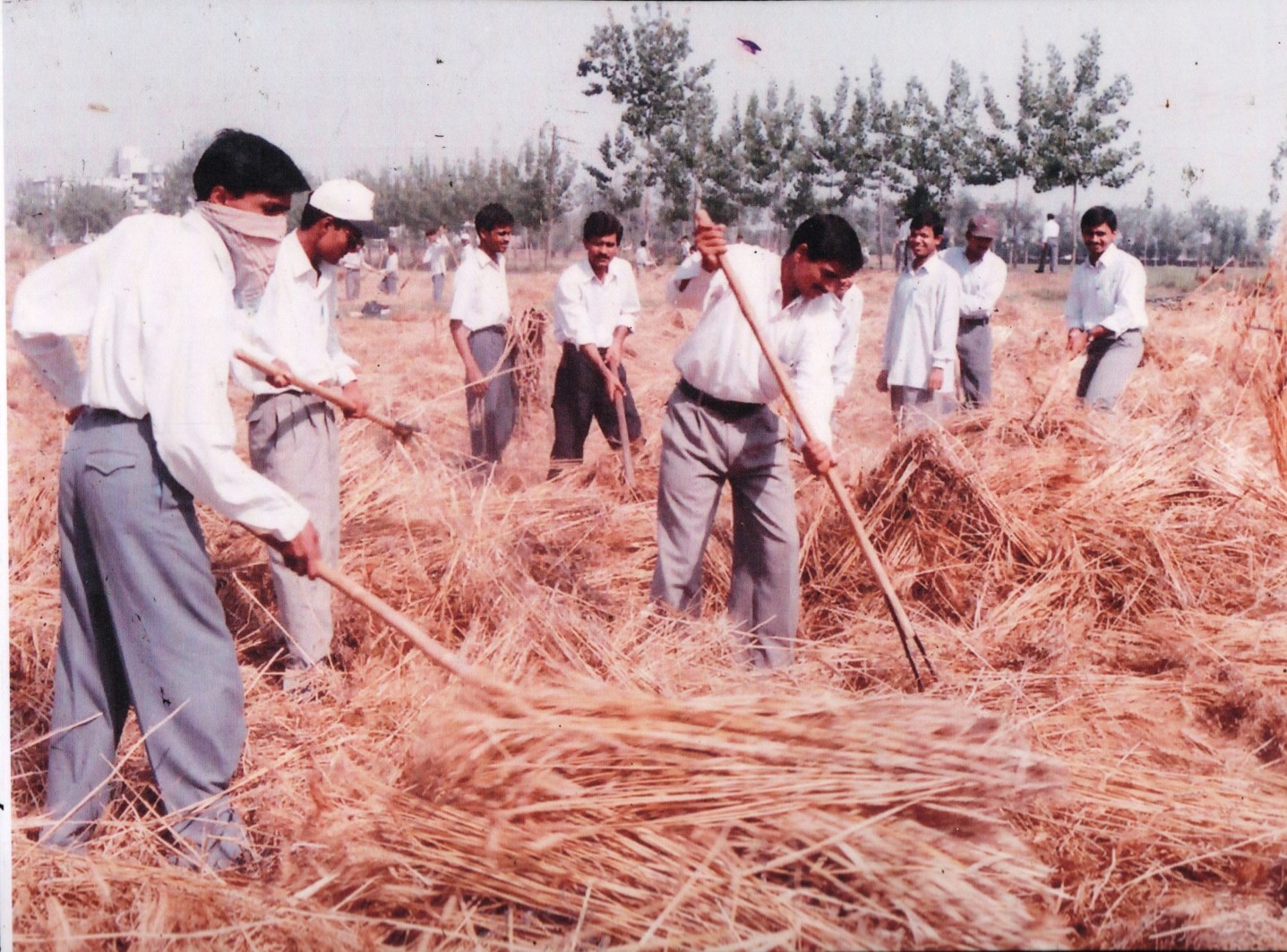
Turning of harvested wheat plants
The Education Policy of Dayalbagh Educational Institute, penned by Revered Dr. M. B. Lal Sahab, highlights the importance of Agriculture Operations as an essential element of the education system of the Institute. The Policy also emphasizes that the Head of the Institute, himself/ herself have an “active involvement in field work so as to infuse staff and students with enthusiasm”. Dayalbagh agriculture operates on scientific principles for which there is a RSSAF Scientific Advisory Committee.

Demonstration of Power Thresher
Agriculture Operations and Rural Development are mandatory core courses for students of all streams in DEI, with students participating in and getting hands-on training in all aspects of agriculture. Further, under NSS, students participate in various farm related and rural development activities. On Sundays, students in large numbers do field work. Students also participate in Gaushala maintenance, Dairy, herbal garden maintenance, biodiversity park development, and mushroom cultivation.

Demonstration of Disc Harrowing
There are plans to start precision farming to optimize utilization of manpower, irrigation water, and soil addendum, and to train students in the modern methods of cultivation. DEI has initiated agriculture education by starting undergraduate courses in B.Sc. Applied Botany and B. Voc. Agriculture Technology and an MBA programme in Agriculture Management.

Harvesting of Barseem
Activities in Progress

Energy conservation and reducing Diesel usage

Wheat, Gram, Mustard, Masoor, Baajra, Barseem and Barley are sown in Dayalbagh every year. Threshing is done to take out the seeds from these crops. The threshers are driven by 3-phase AC induction motors, with the system designed in DEI in collaboration with the Agriculture Department of Dayalbagh.


The electric distribution system for running the threshers with electric motors is designed in DEI with protections, metering, and alarms and appropriately sized cables to minimize voltage drop and losses. Three of the threshing machines run on solar power generated in DEI, reducing the electricity consumption from the Grid and potential downtime due to power failure. A dedicated solar power plant of 50kWp capacity is installed in the Dairy and Agriculture complex. A 20kW capacity Bio-gas plant is being commissioned and will be integrated through a Smart Micro Grid.

Ground water conservation through rain water harvesting and use of sewage treated water
Much of the agricultural irrigation in Dayalbagh is done through sewage treated water from the Sewage Treatment Plant (STP) situated at Dayalbagh. DEI helps Dayalbagh maintain the STP motors for pumping the treated water into canals for irrigation. A Short Messaging Service (SMS) based embedded system for remote monitoring and control of STP pumps has been designed and deployed by the students of DEI.


Integrated solar farming with remote controlled solar assisted micro-irrigation system for local energy use and better farm productivity
The concept of a solar agriculture farm is being developed in DEI. A novel sun-tracking structure has been developed that accommodates 50 solar modules at a minimum ground clearance of 12 feet, thereby facilitating multiple land use, viz. solar-agriculture farm where agriculture can be performed in the land beneath the solar modules. Combination of solar farming with agriculture increases the land yield. The cost of module support structure is compensated by the cost of the land salvaged. This will allow for a through the year solar crop even if the agricultural crop gets affected due to insufficient rains/ otherwise. These multiple land use models would allow large MW size solar plants to be installed near load centres and sub-stations, reducing the cost of grid infrastructure required when these solar power plants are installed on distant barren lands.


Mobile SPV plants for irrigation and other applications
Mobile SPV plants are being developed at DEI which are mounted on a trolley or a vehicle to be used for irrigation in rural areas where erratic or absent electric supply. The vehicle may be towed using a tractor with the SPV modules folded. Whenever required, the SPV modules can be unfolded (manually or motorized) to capture sun light and can power the irrigation pumps or for other uses. A multi-purpose variable frequency drive may be used for irrigation pumps as well as other applications. Typical sizes are 2 – 5 kWp capacity.

Proposed activities

Village Distributed Energy Resource (DER) Grid
Design and development of village DER Grid which would comprise of Irrigation Micro Grid and Residential Micro Grid with possible interoperability. Both micro grids have different load profiles and hence the separation.

Renewable energy solutions for completing the value chain for farmers located at remote places without access to reliable electricity
Extending the village DER grids/ designing efficient and economic stand-alone SPV plants to power cold storages, driers, winnowers, flour/ dal mills, husking machines etc. and complete the value chain for empowering the farmers at remote locations to grow crops of their choice and to get better agricultural land yields.

Data aggregation, data analytics, Machine Learning applications for Village micro grids
Precision agriculture involving sensors, embedded controllers and drip irrigation systems are going to be essential for future organic agriculture. Integrating the sensor data, weather logs and the solar data logs would be useful for efficient irrigation and precision farming. Modern Machine Learning techniques can be used to study and infer potential threats, economics and reliability of the system. Development of such handy software tools will help ensure efficient, economic and reliable operations of DER micro grids encompassing precision agriculture. Cloud storage servers would enable remote monitoring, analysis and control of village DER grids and agriculture.

Drones for precision farming application and surveillance
It is proposed to work on this area for localizing weeds and diseases, determining soil properties, detecting vegetative differences in farms associated with Dayalbagh. However, because of legal restrictions the drone payload should not exceed 5 kg.

Sustainable Development Solutions through Strategic Planning in Agriculture via Interactive Management Strategy
Idea Engineering, Fuzzy DELPHI, Option Field and Option Profile Methodologies along with Scenario Building Exercise and many other techniques of interactive management and system design to be utilized for solutions using Second Generation System Design Paradigm for the said sustainable agriculture initiatives. Such initiatives at sub-system level in Dayalbagh Farming System may be a starting point where deliverables could be used and closely monitored for further nurturing and modifications.

Hydraulic Ram (HYDRAM) for water lifting as a green irrigation initiative
The use of eco-friendly HYDRAM at different identified locations in the farm may reduce costs. A pilot study on use of HYDRAM is proposed.

Sprinkler Systems as Rain-fall Simulators
Besides, other promising areas viz. pico power generation, environmental protection practices, technology assisted organic farming, training and learning initiatives for farmers, students and stakeholders can also be explored and pursued.

Rural Development and Empowering Rural Women

DEI has embarked on a new educational pedagogy of engaging, educating, and improving skills of the rural women. In the remote tribal zones of Madhya Pradesh, ADyNaM (Agri Dairy Nano Processing of Multi-products) Foods has been set up. ADyNaM is a facility for processing of the agricultural and dairy-based raw produce to make secondary products. Women are trained on the production of pickles, chutney, amla candy, and squashes. Recently, a level-1 food testing laboratory has been setup to implement quality control, and to comply with the food safety standards.

Agriculture Education at DEI

In order that the experiential knowledge that Dayalbagh and DEI collectively possess benefits the society at large and contributes to the Nation, Faculty of Agriculture is proposed to be established by DEI after obtaining the necessary approvals and permissions. The Department of Botany got approvals from UGC to start two new courses namely B.Sc. (Hons) Applied Botany and B. Voc. Agriculture Technology from 2017. The Department of Management has initiated an MBA programme in Agriculture Management from 2017 session.

B. Voc. Agriculture Technology students sowing groundnut

Agriculture Operations in Dairying

RSS (Radhasoami Satsang Sabha) Gaushala in collaboration with DEI is transforming into a state-of-the-art Gaushala with the use of RFID, ICT tools, management software, sensors, and modern practices for precise management of nutrition, health, and breeding of cattle. The objective is to develop RSS Gaushala and DEI into a centre of excellence for precision Dairy Farming and Dairy Technology. The effort is to increase milk yield by improving nutrition, health, and breed of the cattle.

Breeding: Database management for maintaining all breeding records using precision Dairy farming software system. The database also records data on heat/ A.I./ calving/ milk yield/ treatment etc. are maintained.

Feeding: Feed planning originates from cultivation of our own crops. Extensive agricultural operations spread over 800 acres and wide range of crops balanced between crops for human and animal consumption is maintained. Each product of crop & its by-product is utilised. Emphasis is on quality & quantity of green fodder, which is the natural and cheapest source of protein. Silage preparation is also done to cater for the lean period.

Facilities Management: Wi-Fi network across the Gaushala provides ready access of information, which is critical for taking spot decisions. There is category & age group-wise housing of the herd. There is a platform weighing scale for monitoring the weight and growth of cattle (calves and heifers). Other B. Voc. Agriculture Technology students sowing groundnut facilities include a cattle bathing shower, similar to a car wash, where the water used for bathing feeds the buffalo pond and thereafter taken for cultivation of crops after getting enriched in urine & cow dung slurry. There is a cow brush parlour, with a sensor-based scrubber and timer. The rotatory movement with brushes relaxes the cows during idle time by reducing itching and increasing blood circulation. The eco-friendly sheds with thatched roofing maintain temperature during summers & winters. Other activities to reduce cattle stress:
  • Playing of devotional music during milking
  • Giving names to each cow & conversing with them using their names
  • Access to clean & fresh drinking water at all times
  • Improving ventilation in sheds by lowering of brick walls
  • Installation of fans in high yielder shed
  • Using thatched roofing in new sheds
  • Khus-chick curtains with drip system and misting are being experimented to reduce the heat stress of the cattle


Dairy Technology Activities in Dayalbagh

Cupid is a logo of REI Dairy products. REI Dairy has been judged as Asia’s best and world’s second-best dairy. On 8th January 1934, Cupid Butter landed in United States after travelling 10,000 miles for 45 days over land and sea without refrigeration and scored 91 points as compared with the score of 92 points scored by the best fresh butter produced in America. Several dignitaries, who visited REI Dairy whole heartedly praised its efficient and professional operations and the quality of its products. In 1935, during his visit to Dayalbagh, Lord Willingdon, Viceroy and Governor General of India, was pleased to call it “the most efficient” Dairy seen by him in many years. Cupid butter was awarded Certificate of Merit in the All India Exhibition of Arts and Industries in Punjab. In 1938, a six months Certificate course on practical training in Modern Dairying and Livestock Management was started at REI Dairy. In 1943, the efficiency of the dairy received a further testimony from the American Forces in Agra, when during 1943-45, they decided to get all their supplies of milk from this Dairy in preference to the Military Dairy in Agra.

Dairy Education at DEI

In 1994, the Dairy became a part of DEI, and work experience training in Dairy products was initiated. In 2015, DEI became the first Deen Dayal Upadhyay Kaushal Kendra in the country with Vocational Programmes in Dairy Technology. Under Kaushal Kendra, B. Voc., M. Voc. and Ph.D. Programmes in Dairy Technology have been approved by UGC. From the 2015-16 session, B. Voc. (Dairy Technology) was launched.

An experimental mini Dairy plant has been setup for providing in-house training to the students. Using this facility, students produce a variety of nutritional value-added dairy products, which not only caters to the needs of the local community and DEI on non-commercial basis, but also gives them practical exposure to entrepreneurship in Dairy Sector. DEI is privileged to have the first student run mini dairy plant in Northern India with FSSAI License, HACCP certification, export permit from Export Inspection Agency, Govt. of India, and commercial permit from US Department of Agriculture for the export of flavoured milk and butter.

The emphasis of these programmes is on entrepreneurship. The B. Voc. (Dairy Technology) has also been launched at the DEI ICT Centre at Amritsar. In December 2016, under Pradhan Mantri Kaushal Vikas Yojana for Technical Institutions through AICTE, a certificate course on Dairy Equipment Operator has been launched. Mini Dairy plants are also being set up in DEI ICT Centres at Amritsar, Timarni and Rajaborari. The objective is to reach out to other regions including remote parts of the country, and provide quality vocational programmes, and contribute to the mission of skilling, entrepreneurship in a scaled up and accelerated mode.

Monday, 31 December 2018

Building Innovators and Creators: Tod-Mod-Jod

Gwynne Shotwell, the President and Chief Operating Officer at SpaceX, states, “You can't be on the cusp of innovation and at the forefront of technology if you're wearing blinders. If you don't have an exploration program where you're exploring your world here on Earth, underwater, and in space, then you're wearing blinders and handicapping yourself”.

Many of the programs at Dayalbagh and DEI are designed to get children to be early explorers. Our post today is on “Tod-Mod-Jod”, a program to build curiosity in children and help them become innovators, creators and inventors.

Happy Exploring,
Anurag


तोD-मोD-जोD


Education is the crucible in which innovations and creativity are nurtured. Promoting creativity and originality through our educational institutions is a first step towards broadening and deepening the impact of innovation in our society and economy. To foster creativity at an early stage and to encourage an innovative mindset in the learners, it is necessary to provide a hands-on learning environment where students can de-construct, re-construct or re-purpose everyday objects that they see or use.


Rationale
The innovative skilling initiative in Dayalbagh Educational Institutions is based on the concept of, “Tod-Mod-Jod” or “तोD-मोD-जोD”, i.e. learning through dismantling, joining, adding, assembling, shaping, designing, redesigning, reshaping. This method of learning is in contrast to the conventional training. तोD-मोD-जोD (TMJ) not only allows students to understand the scientific principles behind the everyday products they use, but also helps the students to expand their horizons to larger concepts and applications so as to enable them to solve real world problems. For instance, students typically do not know the inside of a ceiling fan, तोD-मोD-जोD (TMJ) session would help them to understand how mechanical airflow and electric concepts and components are used.


Description
Dayalbagh Educational Institute introduced तोD-मोD-जोD at middle school level for innovative and self-motivated students who want to create a new product out of those used in daily life. The teacher as mentor encourages students to follow their creative instincts. The feedback from students shows a complete change in their perception towards machines and devices. Curiosity and inquisitiveness are encouraged. These are critical for nurturing an innovative mindset. It is hoped that तोD-मोD-जोD centres will develop a way to excite and challenge young minds in a fun learning environment.


Impact
  • तोD-मोD-जोD centre provides a hands-on learning environment where students can de-construct, re-construct or re-purpose everyday objects that they see or use.
  • Helpful in establishing the concept of learning through “Tinkering”, “Discovery”, and Experimentation”.
  • Early Start towards building a nation of creators not just consumers of products.
  • Make education relevant, real and fun

Student Testimonials
  • “Will always be curious on how what I use actually works”.
  • “Connects multi-disciplinary concepts learnt in textbooks to real life applications”.
  • “We want तोD-मोD-जोD classes every day”.

Friday, 21 December 2018

हे दयाल सद् कृपाल।

The best way to start a day is with a prayer. A prayer not just for our own self, or limited to our families, but for the benefit of everyone in this world, a prayer with faith in Fatherhood of God and a firm belief in brotherhood of all.
The Dayalbagh Educational Institute's Vision book starts with a Foreword from Revered Prof. Prem Saran Satsangi, which has the Institute's prayer for Grace and Mercy for ALL of God's children. The secular prayer is in Hindi and is further translated into seven other languages for the benefit of the readers.
Revered Prof. Prem Saran Satsangi

Students start the day with the Institute prayer
Prayer and translations extracted from the Foreword of the Book are in the post below.


A prayer is an auspicious way to start any activity, and if you start each day with a prayer, every day of your life will be auspicious. Teaching our children to pray from a young age, a prayer, that additionally strengthens their belief in brotherhood of man could be the best gift we can give to the coming generations, something that will give them a world of peace and calm, and allow them to tide over the crisis of divisiveness the whole world faces today.

Regards,
Anurag

Friday, 14 December 2018

Homo Sapiens to Homo Spiritualis

Recently, we were tasked with putting together Dayalbagh Educational Institute's (DEI) vision and next 15 years plan in a book form. Over the next many posts, we plan to post extracts from this book, with this one from the ‘Vision and Mission’ Chapter. Let us all join our minds and hands together in this journey of finding and elevating our soul, a journey from Homo sapiens to Homo spiritualis.

Happy reading.
Anurag


“You see things; and you say, ‘Why?’
But I dream things that never were;
and I say, ‘Why not?
–George Bernard Shaw


Central Administrative Office Dayalbagh Educational Institute

The Dayalbagh Educational Institute’s Vision is ambitious, clearly defined and backed by over a hundred years of experience of imparting quality education. The Vision reflects DEI’s commitment to impart pragmatism together with self-realization. The DEI Education Policy, articulated in 1975, laid down the following foundational concepts:
  • physical, intellectual, emotional and ethical integration of an individual to help evolve the complete man with values of humanism, secularism and democracy, to better equip him to solve social, economic and environmental challenges.
  • truthfulness, temperance and courage
  • ideals of humility, simple living, selfless service and sacrifice
  • habit of learning by developing the faculties of thinking, analysis and reason
  • general awareness and knowledge
  • best in class-relevant education
  • scientific temper
  • respect for ‘soiled hands’, dignity of labour, and, self-reliance
  • study of the classics, and pride in national culture and heritage
  • shaping each student for a calling suited to his aptitude, skills and the needs of society
  • understanding of various beliefs and faiths, which fosters an attitude of tolerance and national unity
  • engendering the spirit of ‘Brotherhood of Man’, and promoting the establishment of a classless and caste-less society
  • fuller understanding of rural life, to appreciate the polity, economy and the social forces at work in our country
  • democratic values and freedoms which an Indian citizen should be prepared to defend
  • respect for the rights of others and an awareness of duties and obligations to society
  • strong character and high ethical standards.

Starting the day with a prayer

This policy was submitted to the University Grants Commission in 1977 for grant of deemed-to-be University status. The UGC team visited the colleges and facilities in the colony of Dayalbagh to assess the potential for achieving excellence with relevance. The Committee’s observations and recommendations endorsed and supported the Policy and its implementation.


Observations and Recommendations of UGC Visiting Team on DEI in 1977
  • At DEI, teaching institutions, industrial-technical workshops, agricultural farms are together engaged in teaching, training, production and extension.
  • Including school children, a community of students, teachers and workers belonging to all castes, creeds, communities and various parts of the country are involved in a variety of programmes for integrated community development.
  • The complex provides a healthy environment for educational innovation and national integration.
  • The DEI is engaged in providing a good academic programme in agricultural-rural-industrial complex, oriented to specific conditions and needs and providing suitable social service, work experience, national integration and vocational training programmes aligning with academic curricula.
  • The DEI is tethered to the principle of excellence but not at the cost of relevance; which inculcates the dignity of manual labour, encourages initiative and creative work; has an interdisciplinary approach to build an integrated personality of a well-adjusted man.
  • The DEI is a departure from the existing pattern of University education.
  • The then Agra University expressed its inability to accord autonomy to DEI as the DEI experiment envisaged the fullest integration, collaboration and cooperation of all the faculties.
  • To enable DEI to develop independently as per its own genius, the DEI should acquire a separate identity with the status of a deemed-to-be-university by which the university system in the country will be enriched.
  • DEI, with its courses, is able to give a greater emphasis on preparing students for self-reliance and self-employment and thus fulfill its objective more effectively.
  • DEI educational programmes address the contemporary needs by applying the most relevant principles of educational process like work-experience, learn by themselves, continuous assessment system, objective methods of assessment, integrated-interdisciplinary and inter-faculty teaching, accent on experimental teaching, production of effective teaching and learning materials and appropriate orientation of teachers.

Vision Statement


To provide linkages to all stakeholders’ potential ‘Values and Quality’ to the kinetic permanent state in a dynamically-oriented and refreshed equilibrium through integrated hierarchical system of education enabled by economic and flexible (jugaad) innovation technology founded firmly on DEI’s Education Policy.

DEI, a leading Entrepreneurship and Consciousness, Teaching-cum-Research Institute, is a model University, measured by its ‘excellence, but not at the cost of social relevance’ reaching up to the last, the least, the lowest and the lost; pursuing research and discovery with frugal innovations contributing with principle of achieving more with less for nation and community-building and beneficial to public at large with cultural reforms enriching and empowering weaker sections, women and children.

In the year 2004, DEI defined its VISION 2011. This policy heralded many features that have later been incorporated in the Nation’s education policy and programs. DEI has been a visionary and forerunner in adopting innovative schemes in the field of education.

The DEI Education Policy – 1975, foresaw many elements of the National Policy on Education – 1986. Similarly, the vocational education programmes of DEI started in 2004, foresaw many elements of the AICTE NVEQF and MHRD Community Colleges schemes launched almost a decade later and is an effort to effectively implement the following national missions for the Socio-Economic Development of the Country:
  • The National Mission of Sarv Shiksha Abhiyan – Universal Elementary Education under the Right to Education Act
  • Make in India
  • Skilling India
  • Digital India
  • Clean India (Swachh Bharat Abhiyan)
  • Unnat Bharat Abhiyan
  • Beti Bachao Beti Padhao Abhiyan
  • Green India
developing respect for ‘soiled hands’, dignity of labour, and, self-reliance

Vision 2031


The Dayalbagh Educational Institute has embarked upon a bold initiative, VISION 2031, and formulated a comprehensive and progressive Strategic Plan for 2012-2031, with the goal to become a top teaching-cum-research Institute through an exemplary system of education. To establish Total Quality Management across all activities of the University, the Plan encompasses undergraduate and postgraduate education, research, infrastructure, information and communication technology and campus development.

The Institute has accepted this challenge and is confident of achieving success with the cooperation of faculty, staff, students, alumni and other interested partners.

Mission Objective


Development of super-intelligent (super-conscious) humans who are self-governed and render selfless service in a rapidly-changing global scenario.

Education in Dayalbagh provides the linkages for this kinetic state in dynamic equilibrium. The linkages have to be  provided at all levels of hierarchy, right from pre-nursery to higher education, through an integrated education system. With technology intervention, this can be extended to the global level. The DEI Education Policy also offers a minimal-input to maximum-output approach through an economic, frugal (jugaad) and flexible model.

The DEI Education model is based on an experiential system rooted in Eastern spirituality and wisdom on the one hand, and modern scientific concepts and Western materialism on the other. While modern science provides solutions to mysteries of the physical world, Saints of the East had knowledge of the highest spiritual regions and consciousness, evolving to better worldliness.

At DEI, teaching institutions, industries and agricultural farms provide the three-dimensional activities for teaching-learning, production, and extension. The social service, work experience, educational innovation, cultural moorings, national integration and vocational training programmes are aligned with academic curricula. A teaching-learning community, including student and staff from pre-nursery to higher education from all castes, creeds, communities, and regions, works toward integrated community development.

Students at DEI

Major goals


DEI has identified the following major goals:
  • Strengthen Entrepreneurial Education giving access to all applicants, even those without means
  • Integrate agricultural farming and dairy education with Entrepreneurial and Consciousness Studies
  • Emerge as an Entrepreneurial and Consciousness University.

A Unique Entrepreneurial University


The emergent model of education allows our students to self-support their education, making them job-creators, rather than job-seekers. Student entrepreneurship provides a platform for students to develop and market a variety of products and services, and capable of starting micro-enterprises, an earn-while-you-learn opportunity with vocational training at low cost.

The entrepreneurship model advocated is unique: the DEI model advocates a frugal, flexible (jugaad) approach to problem-solving rather than seeking funds from venture capitalists, and tries to do ‘more, with less’. We encourage jugaad and frugal innovation: the concept of jugaad does not imply sub-optimal but rather, the creation of a product that is flexible in its usage and has been economically innovated using locally-available materials, manpower and resources. Such products are affordable and cater to local market needs. DEI’s model of entrepreneurship tethers the student-entrepreneur to the rural economy, and also with national and international markets.


Integration of the Green and White Revolutions


Experiential knowledge gained in Dayalbagh’s practice of agriculture and dairy farming has been mainstreamed into education at DEI with the aim of creating the willingness and capacity to work with one’s own hands, promoting a respect for ‘soiled hands’, dignity of labour and a spirit of self-reliance.

Practical knowledge is gained by students where they are involved in the manufacture, distribution and sale of dairy and agricultural produce. The results have been highly encouraging and need to be replicated across the country and around the globe. Participation creates platform for research and labs on land, enabling creation of Intellectual Property by entrepreneurs and researchers.


A major by-product will be a library of successful ideas about agriculture, dairy and entrepreneurship in nano-enterprises in remote and distant villages. This combination of the second white and green revolution in over 400 villages will prove to be a game changer for women and children.

Through technology intervention the benefit of such unique education will be made available to one and all at any time, place and pace around the globe.


Students getting hands-on experience in Dayalbagh Dairy

Excellence in Consciousness Studies


DEI proposes a new science of consciousness scientifically and experimentally, substantiating the existence of higher orders of consciousness through the SQUID (Super-conducting Quantum Interference Device) facility in its own Centre for Consciousness Studies. Our approach as an institute of excellence in consciousness studies is to integrate science and religion by applying the principles and rigour of science and scientific method to religion.

The Institute desires to see its students contribute to one or both of these areas, since a better understanding of either implies an improved ability to contribute to the development of society. Therefore, the education system, with its emphasis on values, is complemented by the inter-, trans- and multi-disciplinary academic curriculum. The Education Policy is based on the systems approach, through a study of science, mathematics, engineering, social sciences, fine arts, etc.


“He will not come into existence in a day; he will
evolve gradually as the human body evolved
gradually according to the Darwinian principle.
As is the case of the body, the mind and spirit will
also evolve gradually, and when the spirit and mind
achieve high purity, a Superman will come into
existence. Such a Superman, through the principle
of administration of inner self, will enjoy inner peace
and harmony and strive continuously to spread
the message of, Fatherhood of God and
Brotherhood of Man”.
–Revered Prof. Prem Saran Satsangi


The DEI mission objective is to transform Homo sapiens into Homo spiritualis: a complete man with balanced development of body, mind and spirit.


Participants of the Sant-Su(perman) scheme with their parents